


Modesto Workers Compensation Lawyer Representing Injured Workers
Suffering a work injury can be overwhelming, but you don’t have to face it alone. At The Law Offices of Roy Yang in Modesto, we understand the impact a serious injury can have on your life, and we’re here to help you understand your options and the workers’ comp process.
As Modesto workers’ compensation lawyers, we assist clients who have been injured in workplace, warehouse, construction, farming, and industrial on-the-job injuries. We provide legal representation in workers’ compensation matters and address disputes with employers and insurance carriers under California law. Our role is to assist with navigating the legal process and procedural requirements involved in a workers’ compensation claim.
Serving Modesto and Stanislaus County and across California, we provide representation to address workers’ compensation claims based on the facts of each case. Call (888) 975-2889 today to speak with a Modesto workers’ compensation attorney.
No attorney fees are charged for the initial consultation. Any attorney fees in a workers’ compensation case are contingent and must be approved by the Workers’ Compensation Appeals Board.
Representative Case Results

$225,000
Construction Accident

$175,000
Warehouse Accident

$150,000
Farming Accident

$75,000
Industrial Accident
Past results do not guarantee or predict future outcomes. Each case is different and depends on its specific facts and circumstances.

Why Choose a Modesto Workers’ Compensation Lawyer?
Workers’ comp cases are local by nature. Your doctors, medical evaluators, and judges are based in or around Modesto, and their patterns are familiar to lawyers who handle claims here regularly.
A Modesto workers’ comp attorney understands how Stanislaus County cases move through the system, and how local insurers and medical providers typically participate in the claims process.
Familiarity With Local Medical Providers and WCAB Procedures
Our team regularly works on workers’ compensation matters involving Modesto-area medical providers, QME/AME evaluations, and WCAB proceedings. We are familiar with how medical evaluations and employer responses are addressed within the local workers’ compensation system. This familiarity helps our team navigate procedural requirements and address claim-related issues as they arise.
Strategies for Pursuing Workers’ Compensation Benefits
The value of your claim depends on more than just filing forms. Our team focuses on documenting wage information, organizing medical records, and responding to issues raised by insurance carriers as part of the workers’ compensation process. This approach helps address claim-related issues and procedural delays that may arise.
Clear Communication Throughout Your Workers’ Comp Case
Our office prioritizes clear communication and timely responses throughout the workers’ compensation process. Clients are kept informed about case developments and can reach our legal team with questions regarding paperwork, deadlines, and procedural requirements.
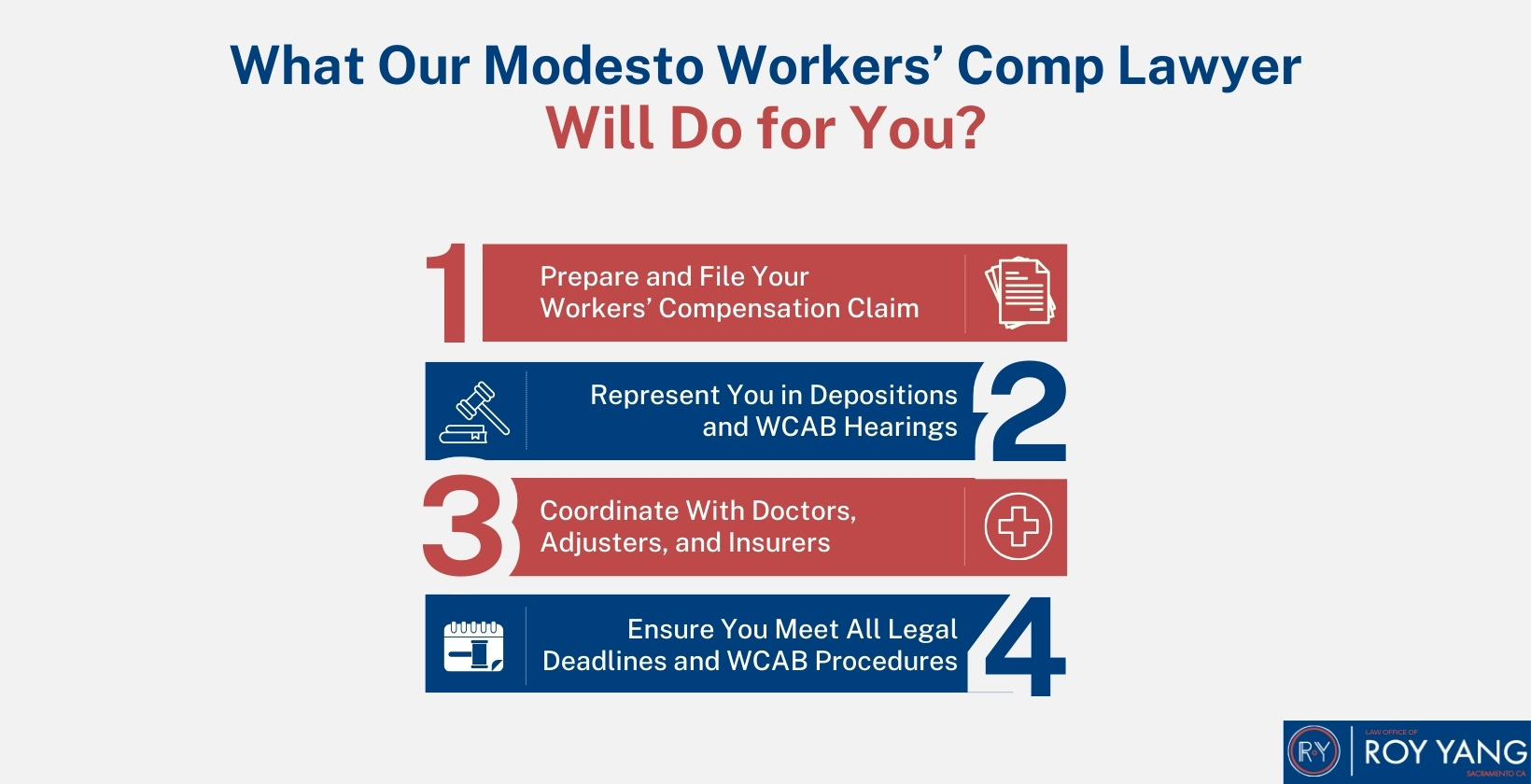
What Our Modesto Workers’ Comp Lawyer Will Do for You?
We handle the day-to-day procedural work involved in a workers’ compensation claim, including preparing filings, tracking deadlines, and responding to insurance carrier requests.
Here’s what our workers’ comp attorney does for your case:
Prepare and File Your Workers’ Compensation Claim
We assist with the preparation and filing of an initial workers’ compensation claim to address documentation requirements and applicable deadlines. This includes gathering medical records and completing the DWC-1 Claim Form as part of the claims process.
We assist with tasks such as:
- Report your injury to your employer and the claims administrator.
- Prepare detailed injury documentation and job impact summaries.
- File required forms with the WCAB and follow up with insurers.
Represent You in Depositions and WCAB Hearings
If you’re scheduled for a deposition, we help you prepare in advance so you understand the process and the types of questions that may be asked. A deposition is a recorded, out-of-court proceeding where a defense attorney asks questions about the circumstances of the claim.
Coordinate With Doctors, Adjusters, and Insurers
Our attorneys assist with communication and coordination involving medical providers, claims adjusters, and insurance carriers as part of the workers’ compensation process. This may include scheduling Qualified Medical Evaluator (QME) or Agreed Medical Evaluator (AME) examinations and addressing requests related to treatment or documentation during the claim.
Address Legal Deadlines and WCAB Procedures
California workers’ compensation claims involve specific filing deadlines and procedural requirements. We assist with tracking and responding to required deadlines, including:
- Monitoring the 30-day injury reporting rule.
- Tracking the one-year statute of limitations for filing a claim.
- Responding to denials, treatment delays, or procedural notices as they arise.
Claim Denied or Delayed? Here's How We Respond
Insurance companies often delay or deny claims due to incomplete records, disputes over injury severity, or internal coverage policies. These tactics cost you time, money, and access to care.
Our legal team assists with responding to denied or delayed claims by addressing procedural issues and following available workers’ compensation processes under California law.
Objecting to Denied Claims with Strong Legal Evidence
We file a formal objection with the WCAB and assist with preparing supporting documentation, including updated medical records, employment information, and injury-related materials. This process may involve submitting supplemental reports to address claim issues and responding to the insurer’s stated reasons for denial through available legal procedures.
Each objection is supported by relevant records and presented in accordance with WCAB requirements.
Requesting Independent Medical Review (IMR) for Denied Treatment
If your treating doctor recommends a specific treatment, but the insurance company’s Utilization Review (UR) denies it, an Independent Medical Review (IMR) may be requested. IMR is a formal process in which an independent physician reviews medical records to evaluate treatment requests.
We help with:
- Submitting the IMR application within California’s 30-day deadline.
- Preparing supporting records showing the treatment necessity.
- Tracking the IMR decision timeline and following up on delays.
Negotiating Fair Settlements with Insurance Companies
Insurance adjusters initially offer lowball settlements to reduce their payouts. We challenge such tactics by leveraging strong medical evidence and a deep understanding of Modesto workers’ compensation laws.
We strategically document your lost wages, future medical needs, and any permanent limitations to negotiate a fair settlement that fully reflects the extent of your injuries and impact on your life.
Demanding Penalties for Unreasonable Delays (Labor Code §5814)
California Labor Code § 5814 allows for penalties when certain benefits are unreasonably delayed or denied. When applicable, a petition may be filed with the WCAB requesting review of the delay.
If penalties are awarded, the WCAB may impose an increase of up to 25% of the delayed benefit amount or up to $10,000, whichever is less, as permitted under the statute. Any determination is made by the WCAB based on the specific facts of the case.
Common Workplace Injuries Covered in Modesto Workers’ Comp Claims
You don’t need a sudden accident or catastrophic injury to qualify for workers’ comp. Many valid claims in Modesto involve conditions that develop gradually from repetitive motion, physical strain, or exposure to harmful environments.
Below are examples of workplace injuries commonly addressed in workers’ compensation claims:

Traumatic Injuries
Serious injuries often require long-term care. Slips, trips, and falls, equipment crush injuries, bone fractures, TBIs, and spinal damage

Repetitive Motion Injuries
Carpal tunnel, lower back strain, and shoulder tendonitis from repetitive work

Occupational Illnesses
Chemical exposure, mold inhalation, and respiratory issues from agriculture or warehouses

Psychological Injuries
PTSD, anxiety, or severe stress from toxic workplaces or traumatic events

Infectious Exposure Injuries
Hepatitis and other diseases from medical or high-risk environments

Burns and Amputations
Chemical or thermal burns, limb loss from machinery, or industrial accidents
Heat-Related Illnesses
Heatstroke, dehydration, and exhaustion in agriculture and construction
California’s workers’ compensation system operates on a no-fault basis, meaning fault is generally not a factor in how claims are reviewed.
Workers’ Compensation Benefits Under California Law
After a work-related injury, many people aren’t sure what they’re actually entitled to under California’s workers’ compensation laws. The system is benefit-based, but what you receive depends on your medical condition, your employment status, and how your claim is handled.
Understanding how workers’ compensation benefits are reviewed under California law can help injured workers better understand the types of benefits that may apply to their claim.
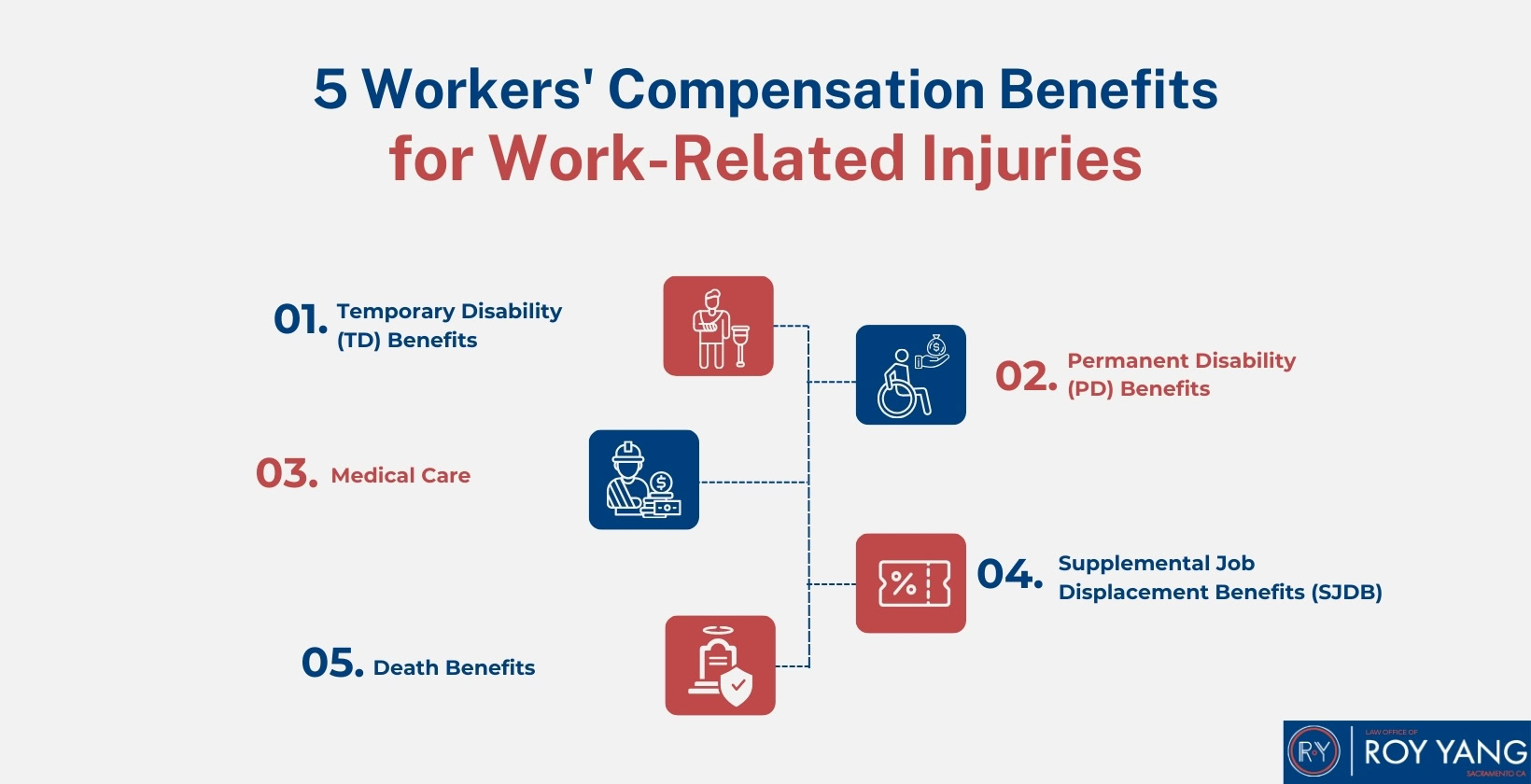
Temporary Disability (TD) Benefits While You Recover
Temporary Disability (TD) benefits are designed to provide wage replacement when a worker is temporarily unable to work due to a job-related injury. These benefits generally begin after a physician determines that work restrictions apply or an overnight hospitalization occurs, and they continue until a return-to-work determination or a finding that the condition is permanent and stationary.
Key Facts:
- Payments are generally calculated at two-thirds of gross (pre-tax) wages, subject to a state-set maximum.
- TD benefits may be paid for up to 104 weeks within five years from the injury date.
Permanent Disability (PD) Compensation for Long-Term Impairment
Permanent Disability (PD) benefits apply when a work-related injury results in lasting physical or mental limitations after a physician determines the condition has reached maximum medical improvement (MMI).
Key Facts:
- A permanent disability rating is assigned based on Qualified Medical Evaluator (QME) or Agreed Medical Evaluator (AME) reports under Labor Code § 4660.
- The rating calculation considers factors such as age, occupation, and the extent of permanent impairment.
- PD benefits may be paid weekly or issued as a lump sum, depending on how the claim is resolved.
Medical Care Paid by Your Employer’s MPN or HCO
Under California workers’ compensation rules, medical treatment for a work-related injury is generally provided through an employer’s Medical Provider Network (MPN) or a certified Health Care Organization (HCO), subject to applicable guidelines and authorization requirements.
Key Facts:
- Covered care may include doctor visits, surgery, prescriptions, rehabilitation services, diagnostic imaging, and necessary medical equipment.
- Treatment requests are reviewed under the Medical Treatment Utilization Schedule (MTUS), and approval depends on whether the care meets MTUS guidelines.
Supplemental Job Displacement Vouchers (SJDB)
A Supplemental Job Displacement Benefit (SJDB) voucher may be available when a work-related injury results in permanent impairment and the employer does not offer modified or alternative work within the required timeframes after a permanent disability evaluation.
Key Facts:
- The voucher may be used for education, retraining, certification programs, tools, books, and related expenses through state-approved providers, up to $5,000.
- Eligibility depends on factors such as permanent impairment status and whether suitable work is offered by the employer.
- Vouchers are non-transferable and generally expire two years from issuance or five years from the injury date, whichever occurs first.
Death Benefits for Families of Deceased Workers
When a worker dies as a result of a job-related injury or illness, California’s workers’ compensation system provides for death benefits that may be available to qualifying dependents.
Key Facts:
- Death benefit amounts range from $250,000 to $320,000, depending on the number of qualifying dependents, such as a spouse, children, or other eligible family members.
- A burial allowance of up to $10,000 may be available to help cover funeral expenses.
- Claims must generally be filed within one year of the worker’s death or within 240 weeks of the injury date, whichever occurs first.
Hear What Our Clients Say
FAQs About Workers' Comp Lawyer in Modesto
How Much does a Modesto workers compensation lawyer charge?
A Modesto workers’ compensation lawyer typically charges a contingency fee that must be approved by a workers’ compensation judge. Fees are commonly approved in the range of 10% to 15% of benefits awarded. No attorney fees are charged up front.
Is it better to settle my workers' comp case or go to trial?
It depends on the facts of the workers’ comp case. Settlement and trial differ in timing, procedure, and risk, and the appropriate option varies based on disputed issues, medical evidence, and claim status.
Can you file a workers' comp claim after termination?
Yes, you can file a workers’ compensation claim after termination if the injury occurred during employment. The claim must still meet California workers’ compensation filing and procedural requirements.
How long does temporary total disability last?
Temporary Total Disability (TTD) benefits in California last up to 104 weeks within five years from the date of injury, subject to medical findings and statutory limits under workers’ compensation law.
What happens if my workers' comp claim is denied?
If your workers’ compensation claim is denied, you have the right to appeal within one year. Filing an Application for Adjudication of Claim is the next step in the process.
What are the chances of winning a workers' comp appeal?
Yes, appealing a denied workers’ compensation claim in California can be successful. Studies show that approximately 67% of workers’ comp appeals lead to favorable outcomes.
How long does it take a judge to approve a workers' comp settlement in California?
It varies and depends on court processing and case-specific factors. Judges review settlements after submission to confirm compliance with California workers’ compensation law.
Can you sue workers' comp for pain and suffering?
No, you cannot sue for pain and suffering. California workers’ comp benefits are limited to medical treatment and wage-related benefits. In limited situations, a separate personal injury claim may exist outside the workers’ compensation system, depending on the facts.
Get Help From the Law Offices of Roy Yang Today
Confused by paperwork or unsure about the status of a workers’ compensation claim? Questions about delays or next steps are common during the workers’ compensation process.
At the Law Offices of Roy Yang, we emphasize clear communication and case transparency. Our workers’ compensation legal team reviews claim information and provides updates regarding procedural status and available options under California law.
If you would like to discuss your situation, you may contact our office to schedule a consultation.
Call now or request your free consultation online.
Injured on the Job? Contact Us.
Know your rights, secure benefits, get treatment, and protect your family’s future. We’re here to help. Contact us.
"(Required)" indicates required fields