


Have you been treated unfairly, denied accommodations, or fired because of a disability? You do not have to face your employer alone.
At the Law Offices of Roy Yang, we understand the fear and financial anxiety that comes with workplace discrimination. Located in Sacramento’s Pocket-Greenhaven area at 1104 Corporate Way, Suite 108, just off Interstate 5, our disability discrimination lawyers provide aggressive legal representation for workers across Sacramento, Placer County, and Yolo County.
Whether you are a California state employee facing bureaucratic hurdles or a private sector worker in the Sacramento Valley, your job is your livelihood. When an employer violates your rights based on a physical or mental disability, they threaten your future. Our firm helps you navigate the complex intersection of FEHA and ADA protections by providing comprehensive advocacy in reasonable accommodation disputes, wrongful termination claims, interactive process guidance, and retaliation protection.
Call (888) 417-7963 to connect with our team and receive a professional review of your matter and legal options.
Understanding Disability Rights in California: ADA vs. FEHA
If you have a disability, then you are protected under both federal and California state law. The Americans with Disabilities Act (ADA) provides a baseline of protection for employees across the U.S. At the same time, California’s Fair Employment and Housing Act (FEHA) often gives broader protections for workers in Sacramento.
Feature | Federal Law (ADA) | California Law (FEHA) |
Employer Size | Applies to employers with 15+ employees | Applies to employers with 5+ employees |
Definition of Disability | Must substantially limit a major life activity | Must only limit a major life activity (easier to prove) |
Mitigating Measures | Considers medication/devices (e.g., if glasses fix vision, you may not be disabled) | Ignores mitigating measures (you are protected even if medication controls symptoms) |
Regarded As | Protects ifthe employer thinks you are disabled | Broader protection for perceived disabilities |
Who is a Qualified Individual?
To be protected, you must be a qualified individual. This means you have the requisite skills and experience for the role and can perform the essential job functions, either with or without a reasonable accommodation. If you can do the core duties of your job but your employer refuses to help you succeed, they may be breaking the law.
What Counts as a Protected Disability at Work ?
California law defines disability broadly. It is not limited to visible physical impairments. It covers any condition that limits a major life activity, such as working, sleeping, or concentrating.
Physical Disabilities
- Chronic conditions (Cancer, Diabetes, HIV/AIDS)
- Mobility impairments requiring wheelchairs or walkers
- Temporary conditions (broken bones, recovery from surgery) if they limit work duties
- Sensory impairments (Blindness, Deafness)
Mental Health & Invisible Disabilities
Discrimination against mental health conditions is rising in Sacramento workplaces. You are entitled to privacy and protection for:
- Clinical Depression and Anxiety
- Post-Traumatic Stress Disorder (PTSD)
- Bipolar Disorder
- Intellectual or Learning Disabilities
Note: You are also protected if you have a history of a medical condition (e.g., cancer in remission) or if your employer regards you as disabled, even if you are not.
How Disability Accommodation Works in the Interactive Process
In California, when an employer knows you have a disability or when you request an accommodation, they are legally required to engage in a timely, good-faith interactive process. It is a legal requirement.
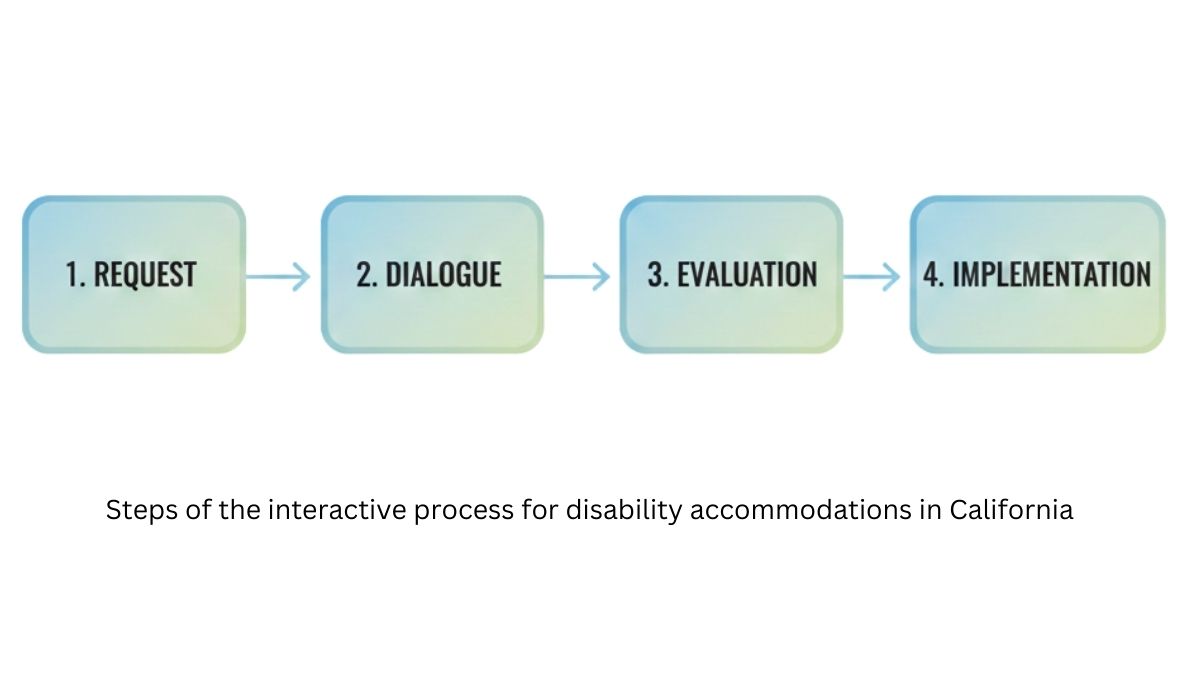
- Notification: The employee (or a representative) discloses a disability-related need.
- Exploration: The employer must communicate with you directly to identify barriers to performance.
- Selection: The employer must consider your preferred accommodation. If they deny it, they must discuss effective alternatives.
- Implementation: A solution is put in place to help you perform your job.
If your employer ignores your request, delays the conversation unreasonably, or creates a blanket policy refusing all accommodations, they may be liable for failure to engage in the interactive process, distinct from discrimination itself.
Reasonable Accommodations vs. Undue Hardship
A reasonable accommodation is a modification to the job or work environment that allows you to perform your essential job functions.
Common examples Include:
- Modified Schedules: Adjusting start times for medical treatments.
- Remote Work: Allowing telework if feasible.
- Assistive Technology: Screen readers, ergonomic chairs, or voice-to-text software.
- Unpaid Leave: Using leave as an accommodation when sick time is exhausted.
- Reassignment: Moving to a vacant position for which you are qualified.
Can an Employer Refuse?
Yes, an employer can refuse, but only if they can prove Undue Hardship. This means the accommodation would cause significant difficulty or expense relative to the employer’s size and resources. Inconvenience is not an undue hardship.
Common Signs of Workplace Disability Discrimination
Discrimination is rarely admitted in writing. It often appears as a pattern of subtle behaviors or policy applications.
Constructive Discharge
Making working conditions so intolerable (harassment, humiliation) that you are forced to resign.
Retaliation
Being written up, demoted, or given worse shifts immediately after requesting an accommodation.
Fit for Duty Abuse
Requiring unnecessary medical exams unrelated to your job duties to screen you out.
Algorithmic Bias
Using hiring software that automatically filters out applicants with gaps in employment due to medical leave.
Exclusion
Leaving you out of meetings or social events after you disclose a condition.
How to Handle a Disability Discrimination Issue at Work?
If you believe your rights have been violated, taking the right steps now can preserve your ability to take legal action later.
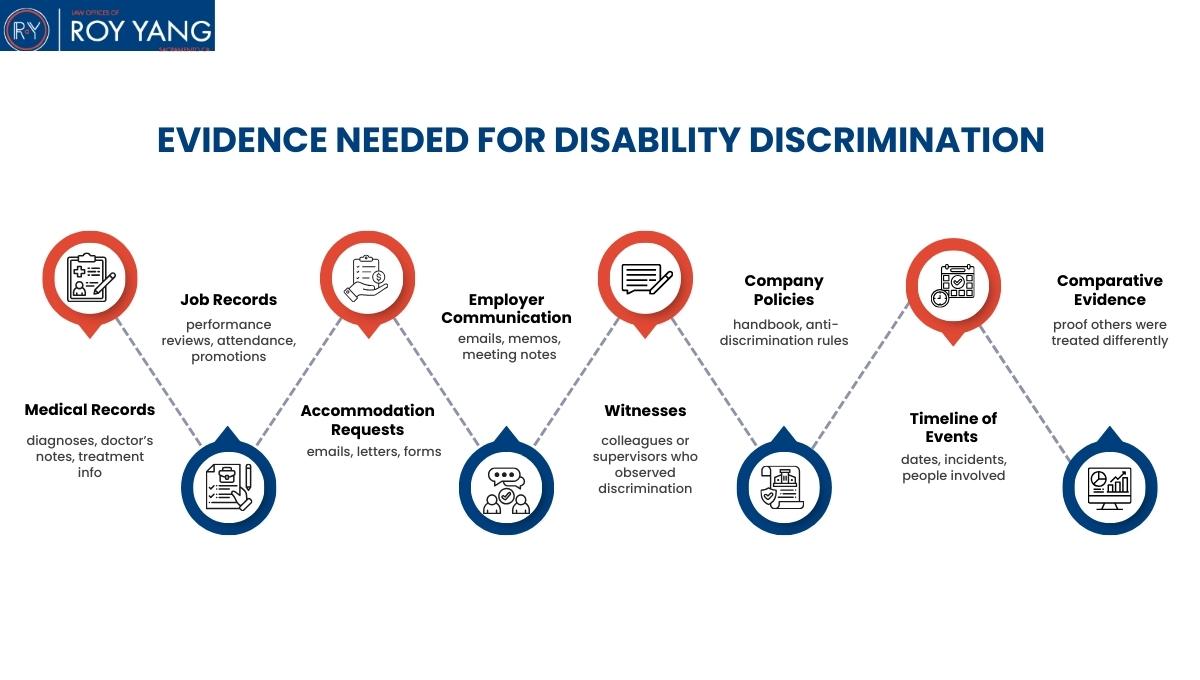
- Document Everything: Keep a personal journal of dates, times, and details of discriminatory incidents.
- Save Communications: Preserve emails, texts, and Slack messages regarding your health or performance. Do not rely on company servers.
- Review Your Personnel File: In California, you have the right to request a copy of your employment file.
- Report the Incident: Follow your company handbook to report the issue to HR in writing. This creates a paper trail proving the company knew about the issue.
- Consult an Attorney: Speak with an employment lawyer before signing any severance agreements or admitting to misconduct.
Statute of Limitations for Filing a Complaint
Time is critical in employment law. If you miss these deadlines, you may lose your right to sue.
- California Civil Rights Department (CRD): Generally, you must file an administrative complaint within three years of the last discriminatory act to sue under FEHA.
- Equal Employment Opportunity Commission (EEOC): For federal claims, you generally have 300 days to file a charge.
If you work for a public entity (like the City of Sacramento or the State of California), you may have much shorter deadlines, sometimes as short as six months to file a Tort Claim. Contact us immediately to verify your specific timeline.
Compensation Available in Disability Discrimination Claims
If we can prove your employer violated the law, you may be entitled to remedies designed to make you whole.
- Lost Wages: Back pay (what you would have earned) and front pay (future lost earnings).
- Emotional Distress: Damages for the anxiety, depression, and pain caused by the discrimination.
- Punitive Damages: Penalties intended to punish the employer for malicious or reckless conduct (available under FEHA).
- Reinstatement: Ordering the employer to give you your job back.
- Attorney’s Fees and Costs: The court may order the employer to pay your legal fees.
Why Sacramento Workers Choose Law Office of Roy Yang
Employment litigation requires a deep understanding of local courts and state-specific mandates. The Law Office of Roy Yang provides straightforward, practical guidance grounded in the local landscape.
- Local Focus: We know the Sacramento Superior Court (Gordon D. Schaber Courthouse) and the Eastern District Federal Court. We understand the unique protections for state workers and union members.
- Client-Centered: We strip away the confusing legal jargon and focus on your goals.
- No Upfront Risk: We work on a contingency fee basis. You do not pay us for our time unless we settle your case or win a verdict.
Serving the Greater Sacramento Region: We represent clients in Elk Grove, Roseville, Citrus Heights, Davis, West Sacramento, and Folsom.
Client Reviews and Testimonials
The following testimonials reflect feedback clients have shared about their experience working with the Law Office of Roy Yang, including professionalism, responsiveness, and clarity in communication.
Get a Free Confidential Case Review
Your career and your health are worth fighting for. If you are facing barriers at work, retaliation, or wrongful termination due to a disability, contact our disability discrimination attorneys at the Law Offices of Roy Yang today.
We offer a free, confidential consultation to review your situation. We will listen to your story, explain your rights under California law, and help you decide the best path forward.
Call (888) 417-7963 or contact us online to get a free confidential review of your workplace discrimination case.
Frequently Asked Questions
How Do I Prove Disability Discrimination at Work?
Proving discrimination often requires circumstantial evidence. We look for temporal proximity (did bad treatment start right after you disclosed a disability?), comparators (were non-disabled employees treated better for the same behavior?), and violations of the employer’s own policies.
Can I Be Fired While on Disability Leave?
Generally, you cannot be fired because you are on leave. However, being on leave does not give you absolute immunity. If the employer conducts a company-wide layoff unrelated to your leave, you may still be affected. Proving the reason for the termination is key.
Can My Employer Ask For My Medical Diagnosis?
Generally, no. Your employer is entitled to know your functional limitations (what you can’t do) to provide accommodations, but they typically do not have the right to your specific medical diagnosis or full medical records.
Is Stress Considered a Disability in California?
Stress itself is usually not a disability, but the underlying condition causing it, such as Generalized Anxiety Disorder or Hypertension, often is. If a doctor diagnoses you with a condition that limits your ability to work, you may be protected.
Do I Need a Doctor’s Note to Request a Reasonable Accommodation?
It depends. To request a reasonable accommodation, you may need basic medical information if your condition is not obvious. The employer can ask for documentation showing the need, not detailed medical records.
Disability Discrimination at Work? Contact Us.
Know your rights, secure benefits, get treatment, and protect your family’s future. We’re here to help. Contact us.
"(Required)" indicates required fields