



SACRAMENTO REPETITIVE STRAIN INJURIES ATTORNEY
Repetitive strain injuries creep up slowly, but the financial impact hits fast. If carpal tunnel, tendonitis, or back strain, or other conditions are keeping you from working, California workers’ compensation may cover you – and we know how to fight for it.

Why Hire Our Sacramento Repetitive Strain Injuries Lawyer?

Committed to protecting clients' rights and pursuing favorable outcomes through diligent legal representation.

From 2005 to 2026, Representing clients throughout California with dedicated, personalized legal guidance.

Personalized attention, responsive communication, and dedicated legal support from start to finish.

Speak with an experienced attorney at no cost to discuss your legal rights and options.
You did not expect gradual pain from your job, but now tingling in your wrists, numbness in your fingers, or chronic back strain is affecting your ability to work. Repetitive strain injuries (RSIs), including carpal tunnel syndrome, tendonitis, bursitis, trigger finger, and lower back strain, qualify for benefits under California’s no-fault workers’ compensation system. Even though these injuries develop over time rather than from a single accident, you do not need to prove your employer did anything wrong, only that your work caused or contributed to the condition.
Insurance carriers often challenge these claims, arguing the condition stems from hobbies, aging, or pre-existing conditions, and use California’s apportionment rules to reduce what you recover.
At Roy Yang Law, our Sacramento repetitive strain injury attorneys have represented workers in RSI and cumulative trauma claims for more than 20 years. We know how insurers build these arguments and how to counter them.
Call us at (888) 975-2889 or schedule your free case review today. There is no fee unless we recover compensation for you.
Posted on Google
 Shawntay T
Trustindex verifies that the original source of the review is Google.
Mr. Yang and his team were fantastic every step of the way. The legal assistants were extremely helpful, and Mr. Yang was always informative and ready to answer all my questions. Highly recommend!Posted on Google Alejandro TorresA very efficient law firm handled my case efficiently and was always in contact with me. Jennifer Aguilar was very professional and kept me informed about the progress of my case. They resolved it in less than a year, and I had a check for my workers' compensation in hand. Highly recommended.
(Translated by Google, see original)Posted on Google James SodermanI had a very positive experience with my workers’ compensation attorney. From the beginning, they were professional, knowledgeable, and took the time to explain the process and answer my questions. They kept me informed throughout my case and made sure I understood what was happening every step of the way. I really appreciated how they listened to my concerns and worked hard to protect my rights and interests. Having someone experienced on my side made a stressful situation much easier to deal with. I would definitely recommend this attorney to anyone who is dealing with a workers’ union compensation case and needs someone they can trust.Posted on Google
 gregg sparkmanI would highly recommend the law office of Roy Yang. They where all very professional and helpful. Explained everything thoroughly and gave me peace of mind.Posted on Google
 Marco VelasquezI was very satisfied with the legal services I received. From the very beginning, they demonstrated expertise in the field and, most importantly, resolved my situation much faster than I expected. If you're looking for results and excellent service, this is the place to go.
(Translated by Google, see original)Posted on Google Mario FigueroaI am a client of Roy Yang's Law Office. They have been handling my case for over two years. The customer service provided by Sandra and Jennifer has been exceptional. I highly recommend them to the Latino community if they have had a workers' compensation experience. Sandra guided me through the entire process with complete sincerity and dedication. She is one of the best.
(Translated by Google, see original)Posted on Google Juan Ramón Cubas cantillanoAt Roy Yang's law office, I received the necessary assistance with my workplace accident case. They have extensive experience, and I personally felt very well taken care of. Whenever I called with a question, I was always very well attended to, especially by Ms. Sandra, who was very kind, always cordial, and willing to help me resolve any issues. I recommend Roy Yang's law office 100%. I am truly satisfied with the work done on my case. I wish everyone at the office much success and abundant blessings. Oh, and one more thing I almost forgot: they are a great help to our Latino community. Don't hesitate to contact them; they will assist you kindly and in Spanish.
(Translated by Google, see original)Posted on Google Brian WilliamsHelped to Settle my Work Comp case within 4 months of Adjucation for a Nice Amount Very Fast for work compensation stuff I would recommend. 5 starsPosted on Google
 Guero GarciaI got injured at work in 2023 and got terminated i went to Mr. Roy Yang. I tell u hes a friendly kind straight up person he dont beat around the bush and straight to the point. And all i can say is thank u Mr. Yang for ur time and getting me a great settlement. I highly recommend himPosted on Google
 IsaiahVery good law firm from start to end Mr. Roy and his team makes sure you receive all medial care needed with a positive outcome very pleased with this firm returning clientPosted on Google
 Jack D
Trustindex verifies that the original source of the review is Google.
The end result was solid, even though it took awhile to get there. My case worker, Sandra, was absolutely fantastic. She communicated well, was patient, and very kind and helpful. Definitely the best part of my experience. While I really only dealt with Roy Yang two times during the roughly 2 year process from start to finish, both times he was offputting and dismissive. His opening salvo the first time I spoke with him after signing up was basically "whatever your expectations are, lower them", which isn't really what one wants to hear from their attorney at the get-go. The 2nd time I spoke with him, we had a meeting regarding how to move forward with the case, which had basically been in limbo. I questioned why the associated costs of surgery weren't being picked up by the insurance company, to which he alarmingly answered "what surgery"? He then stated he had no information on that doctor's visit and summary, and I needed to call the doctor to get the proper records. I spent 3+ hours of my day off getting these records, signing release forms, and going back and forth with the doctor's office, only to find out that they had them the entire time. He just wasn't organized or prepared properly. He had no real plan to increase the C&R value of my case after the initial appraisal of my case was a low dollar value, as the insurance company had no interest in covering surgery for a C&R. I had to come up with my own plan to get the insurance company to cover the cost of surgery, which ended up working out, luckily. If I had just followed his lead and left him to his own devices, I would have ended up with about half of the value of what I ended up getting. I asked my case worker to just deal with her only from that point forward until we concluded the case. If it wasn't for Sandra and all of her hard work, this case likely wouldn't have gone well. I understand that in order for Workers Comp litigation to be profitable, that these firms need to take on a disproportinate amount of cases. A little more care and attention to detail from the actual lawyers would go a long way here, though. To the individual looking for representation, this is likely going to be their ONLY case dealing with Workers Comp, and it can be an important and life altering experience. The ONLY reason I'm not giving a lower score is due to Sandra and the rest of the office/case worker staff for going so far above and beyond my expectations. They, especially Sandra, were fantastic and really made the experience a positive one, despite my reservations about the attorneys.Posted on Google YVONNE M MoodyHe was a GREAT HELP to us with our case..I would recommend him...Thank you to Mr Yang and staff, for everything!!Posted on Google
 AndrewThe front desk and everyone else were very helpful and accommodating. I walked in without any appointment or phone call, showed a few documents, and they took my case immediately. You will be in good hands here.Posted on Google
 UlisesThey are very professional, thank you for helping me. I would recommend them.
(Translated by Google, see original)Posted on Google Lilián QuiroaThe Law Office of Roy Yang, especially the assistant Sandra, offered me very attentive and professional service. I highly recommend them with the certainty and confidence of knowing that they will provide the help and assistance you need in any case related to work injuries.
(Translated by Google, see original)Verified by TrustindexTrustindex verified badge is the Universal Symbol of Trust. Only the greatest companies can get the verified badge who has a review score above 4.5, based on customer reviews over the past 12 months. Read more


Remarkable Settlements

$225,000
Construction Accident

$175,000
Warehouse Accident

$150,000
Farming Accident

$75,000
Industrial Accident
Common Causes of Repetitive Strain Injuries in Sacramento Workplaces
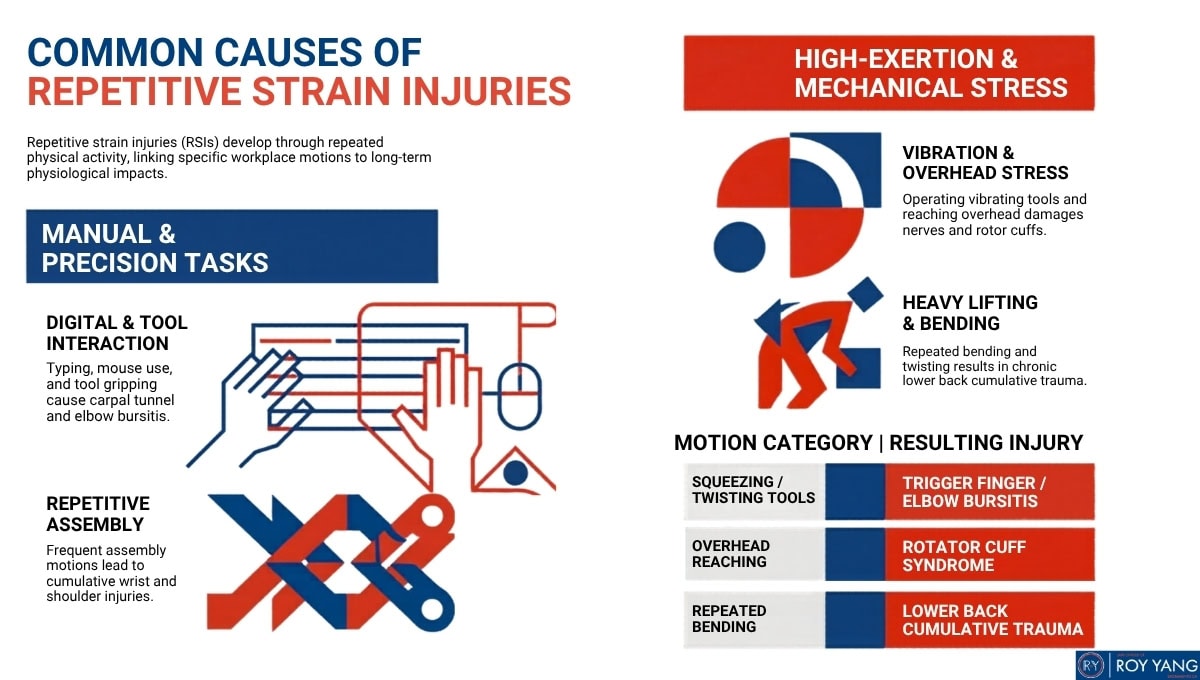
Repetitive strain injuries develop from repeated physical activity over time, not from a single incident. Common causes include:
- Typing or mouse use: Causes carpal tunnel syndrome or wrist tendonitis.
- Gripping, twisting, or squeezing tools: Causes trigger finger or elbow bursitis.
- Repetitive assembly motions: Result in wrist and shoulder injuries.
- Operating vibrating tools: Leads to nerve damage or rotator cuff injuries.
- Overhead reaching or lifting: Causes rotator cuff syndrome or shoulder tendonitis.
- Repeated bending, twisting, or heavy lifting: Results in lower back cumulative trauma.
Symptoms of a Repetitive Strain Injury at Work
Repetitive strain injury symptoms start gradually and worsen over time if the underlying cause is not addressed. Common signs include:
- Pain or burning: Discomfort during or after work that gets worse with continued activity.
- Numbness or tingling: Reduced sensation in the fingers, hands, or arms during or after repetitive tasks.
- Stiffness: Joint or muscle stiffness that is worse on workdays and improves on days off.
- Reduced grip strength: Difficulty holding or controlling objects that were previously easy to manage.
- Swelling or tenderness: Localized inflammation or sensitivity around the wrist, elbow, or shoulder.
- Clicking or locking: Catching or popping in the fingers, wrist, or shoulder during movement.
- Persistent limb fatigue: Ongoing sensation of heaviness or exhaustion that does not improve with rest.
A clear pattern of symptoms worsening during the workweek and improving on weekends strongly supports that your condition is work-related.
If your symptoms have been progressing, call us at (888) 975-2889 or request your free consultation.
How RSIs Are Diagnosed and What Treatment Looks Like
If you are experiencing RSI symptoms, a doctor will typically confirm the diagnosis through a physical examination and imaging. Ultrasound, X-rays, and MRI scans are commonly used to assess soft tissue damage, nerve compression, and joint involvement. For conditions like carpal tunnel syndrome, nerve conduction studies may also be ordered.
Conservative treatment usually comes first. This includes activity modification, anti-inflammatory medications, splinting, physical therapy, and corticosteroid injections. Surgery is reserved for cases where conservative care has not resolved the condition or where structural damage requires repair.
From a workers’ compensation standpoint, every treatment step matters. Your medical records form the evidentiary backbone of your claim. Consistent treatment with clear documentation of work-related causation is what the insurance carrier and any QME will rely on. Gaps in care are one of the most common tools insurers use to challenge RSI claims.
What Happens If a Repetitive Strain Injury Is Left Untreated?
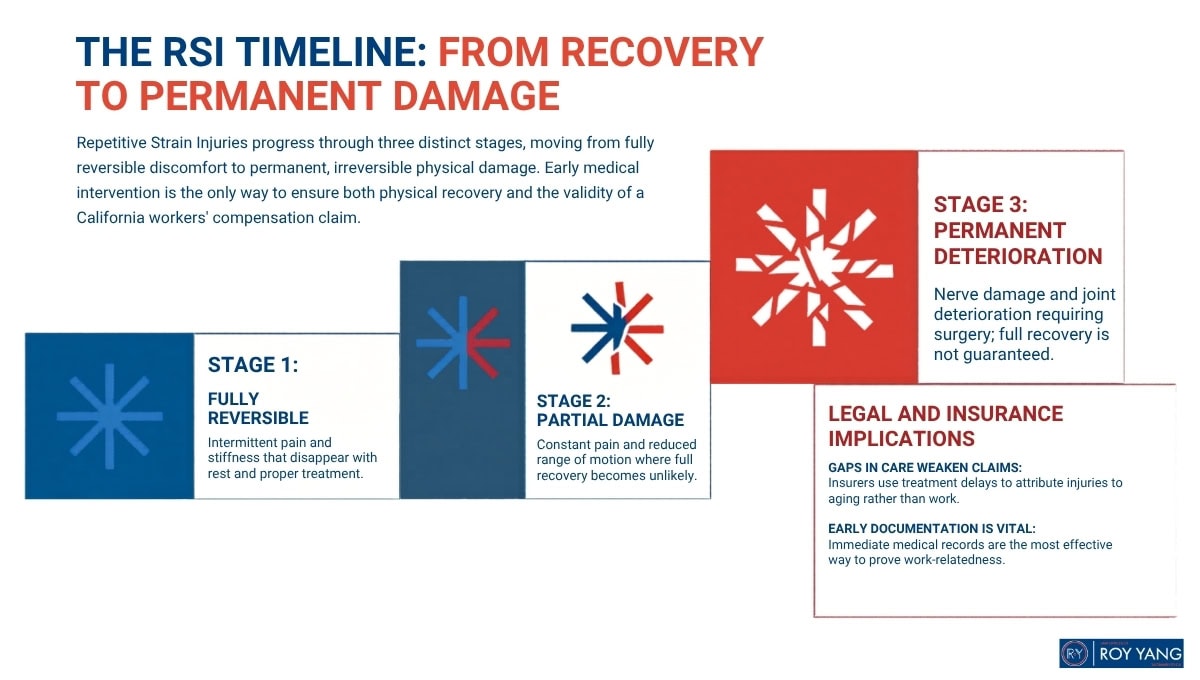
Untreated repetitive strain injuries progress from mild discomfort to permanent physical damage that cannot be fully reversed.
- Early stage: Intermittent pain and stiffness that appear during work and improve with rest. At this stage, the condition is fully reversible with proper treatment.
- Middle stage: Pain becomes constant, with reduced range of motion and partial damage to tendons, muscles, or ligaments. Full recovery is no longer likely without timely care.
- Late stage: Permanent nerve damage, chronic weakness, and joint deterioration develop. Surgery is required at this stage, and full recovery is not guaranteed.
Delaying treatment weakens your claim. Insurance carriers use gaps in medical care to argue your condition stems from aging or non-work activities rather than your job duties. Early medical documentation is the most effective way to establish that your injury is work-related under California workers’ compensation law.
How California Workers' Compensation Law Applies to RSI Claims
Repetitive strain injuries are covered under California workers’ compensation law. You do not need a single accident or specific incident to be eligible to file a valid claim.
- Cumulative injury: RSIs result from repeated work-related activities over time rather than a single traumatic event (Labor Code §3208.1(b)).
- AOE/COE standard: Your condition must be caused or contributed to by your job duties, not personal activities outside of work.
- Date of injury: The date of injury is when you first experienced disability from the condition and knew or should have known it was work-related, not when symptoms first appeared (Labor Code §5412).
- Pre-existing conditions: If your job aggravated an existing condition, your claim is still valid.
- Exclusive remedy: In most cases, workers’ compensation is the sole remedy against your employer. However, if a third party’s negligence contributed to your injury, a separate civil claim may be possible alongside your workers’ comp case.
Evidence That Strengthens Your RSI Workers' Compensation Claim
RSI claims require clear documentation linking repetitive job duties to your diagnosed condition. Because there is no single accident, documentation is the foundation of your claim.
- Job duties: A detailed description of your daily physical tasks, including motions, frequency, duration, and tools used
- Symptom timeline: A personal record of when symptoms began, how they progressed, and which tasks made them worse. This counters insurer arguments that the condition developed outside of work or existed beforehand.
- Medical records: Physician diagnoses, treatment notes, and imaging results. Both insurance adjusters and QMEs rely on your medical record; any gap in treatment can weaken your claim.
- Reporting records: Written proof that you reported the injury to your employer, including the date and method. Verbal reports alone are difficult to verify.
- Work schedule: Time records, pay stubs, or schedules showing the frequency and duration of repetitive tasks
- Prior injury history: Medical records showing any previous conditions and whether they were stable before your job duties worsened them. This directly affects apportionment, the insurer’s primary tool for reducing permanent disability benefits.
Gathering and organizing this evidence early is critical, especially during the insurer’s 90-day investigation period.
What Happens After You Report a Repetitive Strain Injury at Work in Sacramento?
Reporting a repetitive strain injury triggers a set process under California workers’ compensation law.
Step 1: Report your injury in writing
Written notice creates an official record of your claim. Verbal reporting alone is difficult to prove and can lead to disputes about whether timely notice was given.
Step 2: Employer provides Form DWC-1
Your employer must provide the DWC-1 Form within one working day of being notified. Complete and return it to the insurance carrier. If your employer does not provide it, request it directly from the California Division of Workers’ Compensation.
Step 3: Insurer authorizes initial treatment
Once the insurer receives your completed DWC-1, they must authorize up to $10,000 in medical treatment, even before the claim is formally accepted or denied.
Step 4: The insurer has 90 days to accept or deny the claim
Under Labor Code §5402, if the insurer does not deny the claim within 90 days, it is presumed compensable under California law. RSI claims are often fully investigated during this period, making early documentation important.
Step 5: If the claim is accepted
Treatment is provided through the insurer’s Medical Provider Network (MPN), a group of pre-approved physicians. In most cases, you are required to treat within this network. If you previously designated your own physician before the injury, you may be able to continue treatment outside the MPN.
Step 6: If the claim is denied
You can file an Application for Adjudication of Claim with the Sacramento Workers’ Compensation Appeals Board (WCAB). A judge will review medical evidence and hear arguments through the workers’ comp appeals process before issuing a decision. These cases may involve depositions, formal hearings, and multiple proceedings before resolution.
Your Right to File Without Fear of Retaliation
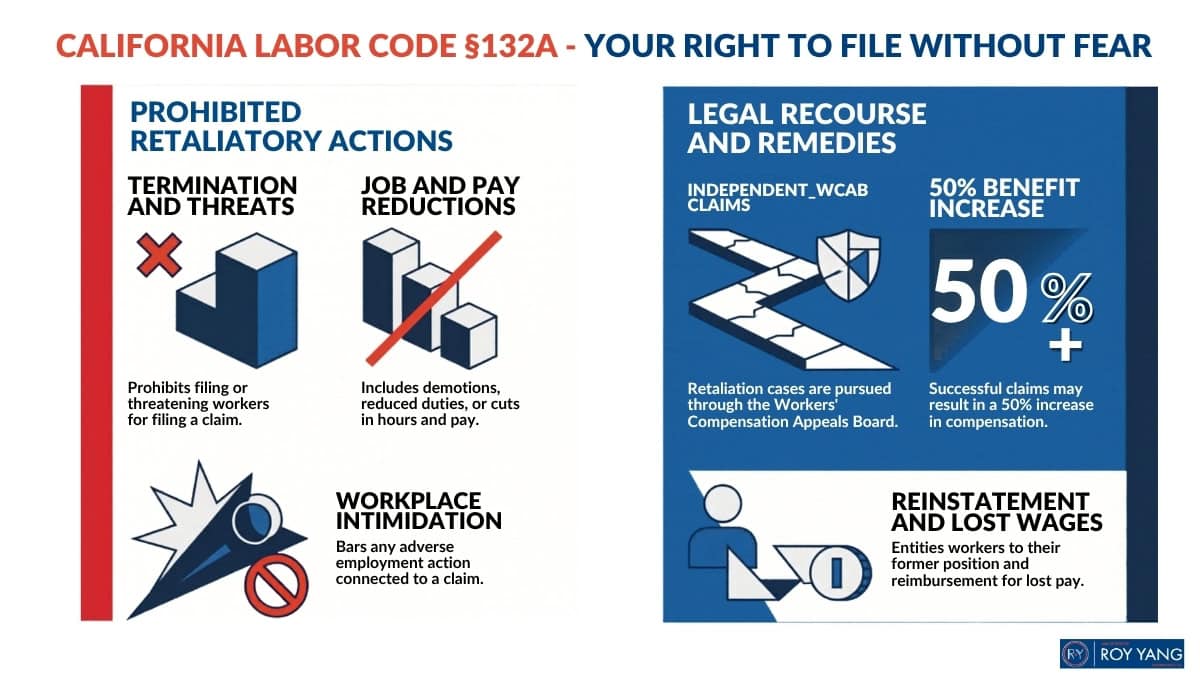
California Labor Code §132a protects workers from retaliation for reporting a repetitive strain injury or filing a workers’ compensation claim. Prohibited actions include:
- Termination or threats of termination connected to a filing
- Demotion or reduced job duties
- Reduction in hours or pay after filing
- Intimidation or any adverse employment action connected to your claim
Retaliation is a separate legal violation from your workers’ compensation case and can be pursued independently through the Workers’ Compensation Appeals Board (WCAB). A successful retaliation claim entitles you to reinstatement, lost wage reimbursement, and a 50% increase in workers’ compensation benefits, up to a maximum of $10,000, under Labor Code §132a.
Fear of retaliation is one of the most common reasons injured workers delay reporting RSI symptoms. Those delays give insurers grounds to argue the condition is not work-related, which can reduce or eliminate your benefits.
Workers' Compensation Benefits Available for Repetitive Strain Injuries in Sacramento
California workers’ compensation benefits for RSI claims include medical treatment, disability payments, and retraining assistance, with eligibility and amounts set by state law.
Medical Treatment
All reasonable and necessary care related to your injury is covered under Labor Code §4600, including doctor visits, specialist care, physical therapy, surgery, imaging, and prescription medications. There is no dollar limit on approved treatment.
Temporary Total Disability (TTD)
If your injury prevents you from working during recovery, you receive two-thirds of your average weekly wages, subject to state minimums and maximums (which are adjusted annually), for up to 104 weeks within a five-year period.
Temporary Partial Disability
If you return to modified or lighter-duty work during recovery, you receive two-thirds of the difference between your pre-injury wages and your reduced earnings.
Permanent Disability (PD)
If your RSI causes lasting limitations, you receive ongoing weekly payments based on a state-assigned disability rating. Apportionment under Labor Code §4663 may reduce the award if part of the condition is attributed to non-work-related factors.
Supplemental Job Displacement Benefit (SJDB)
If you cannot return to your previous job and your employer does not offer suitable modified work, you are entitled to a $6,000 voucher for retraining or education.
Death Benefits
If a work-related RSI results in death, qualifying dependents receive burial expense reimbursement and ongoing weekly payments under Labor Code §§4700–4707.
How a QME Impacts Your RSI Workers' Compensation Claim
A Qualified Medical Evaluator (QME) is a physician certified by the California Division of Workers’ Compensation who resolves medical disputes in workers’ compensation claims, distinct from your treating physician. QME involvement is triggered when:
- The insurer disputes that your RSI is caused by your job duties
- There is disagreement about your permanent disability rating
- The insurer denies treatment recommended by your treating physician
Under Labor Code §4062.2, the DWC provides a panel of three QMEs in the appropriate specialty. The requesting party must select one within a strict deadline. Missing that deadline results in losing the right to choose, allowing the other side to select the evaluator.
The QME report determines whether your injury is work-related, your permanent disability rating, and your entitlement to future medical care. It is one of the most consequential steps in the workers’ compensation claim process.
Apportionment (under Labor Code §§4663 and 4664) divides permanent disability between work-related and non-work-related causes. It is the insurer’s primary tool for reducing permanent disability awards in RSI cases. Strong medical documentation is the most effective counter to an apportionment finding.
When both parties are represented by attorneys, they may agree to use an Agreed Medical Evaluator (AME) instead. If either party is unrepresented, the §4062.2 panel process applies.
A QME report can be challenged, but success depends on timely preparation and on documentation established before the evaluation.
Why Injured Sacramento Workers Trust Roy Yang With Their RSI Claim
RSI claims require strategic development from the beginning, and the attorney handling your case needs proven experience in California workers’ compensation disputes. At the Law Offices of Roy Yang, attorney Roy Yang has more than 20 years of experience representing injured workers across Northern California. We know how insurers manage these claims, the apportionment arguments, the QME disputes, and the denial strategies.
Our approach is built on:
- Proven experience: More than 20 years handling RSI and cumulative trauma claims across Northern California, including cases involving disputed causation, insurer apportionment challenges, QME disputes, and denied benefits at the WCAB.
- Documented proof development: Our team builds the evidence needed to establish repetitive work exposure, connect job duties to your diagnosed condition, and prepare your claim against insurer challenges.
- Apportionment defense: We counter insurer apportionment arguments using targeted medical documentation and legal strategy to protect your permanent disability award.
- WCAB representation: Our lawyers represent injured workers before the Sacramento Workers’ Compensation Appeals Board when claims are denied or disputed, from negotiation through litigation.
- No upfront cost: You pay nothing unless benefits are recovered on your behalf.
Hear What Our Clients Say
Common Questions About Repetitive Strain Injury Claims in California
Can I File a Workers' Comp Claim If My RSI Was Pre-Existing But Worsened at My Sacramento Job?
Yes. California workers’ compensation covers pre-existing conditions that were aggravated or worsened by job duties. If your work contributed to the condition, your claim is valid. Apportionment may reduce your permanent disability award based on non-industrial causes, but it does not eliminate your claim.
How Long Do I Have to Report And File an RSI Workers' Comp Claim in California?
You have 30 days to report your RSI to your employer. The statute of limitations to file a workers’ compensation claim is one year from the date of injury under Labor Code §5405. For RSIs, the date of injury is when you first experienced disability and knew or should have known it was work-related.
What If My RSI Workers' Comp Claim Is Denied in Sacramento?
A denied RSI workers’ comp claim is not final. You can file an Application for Adjudication of Claim with the Sacramento Workers’ Compensation Appeals Board to challenge the denial. A Workers’ Compensation Judge will review medical evidence and hear arguments.
Can I Choose My Own Doctor For an RSI Workers' Comp Claim?
It depends. In most cases, treatment is provided through the insurer’s Medical Provider Network. If you pre-designated a personal physician in writing before your injury, you may treat outside the network. If no pre-designation exists, you are generally required to treat within the MPN.
How Much Does a Sacramento RSI Workers' Comp Attorney Cost?
Hiring our Sacramento RSI attorneys costs nothing upfront. At Roy Yang Law, we work on a contingency basis, meaning you pay nothing unless we recover benefits on your behalf. Our fees are subject to approval by a Workers’ Compensation Judge and are capped under California law.
What If My Employer Does Not Have Workers' Compensation Insurance?
California law requires nearly all employers to carry workers’ compensation insurance. If your employer does not, you still have options. You can file a claim through the California Uninsured Employers Benefits Trust Fund (UEBTF), which covers workers injured by uninsured employers. You may also have the right to pursue a direct civil lawsuit against your uninsured employer under Labor Code §3706, a separate exception to the exclusive remedy rule. If you are unsure whether your employer is insured, we can help you verify coverage status at no cost to you.
Talk to a Sacramento RSI Workers' Comp Attorney Today
RSI claims require early action. The longer you wait, the more ground insurers have to challenge causation, dispute medical records, and reduce what you recover. At Roy Yang Law, our Sacramento RSI attorneys move quickly to protect your evidence, strengthen your claim, and narrow the grounds for denial from the start.
You focus on recovery. We handle everything else.
What to expect at your free case review:
During your consultation, we will review the details of your injury, your job duties, and any documentation you have. You will leave with a clear understanding of whether you have a viable claim, what steps to take next, and how the process works. There is no obligation and no cost.
Call us at (888) 975-2889 or schedule your free case review today. There is no fee unless we recover compensation for you.
Get a free, no-obligation case evaluation from an experienced workers’ compensation attorney.
Or fill out the form
"(Required)" indicates required fields

No fee unless we win
Injured on the Job? Contact Us.
Know your rights, secure benefits, get treatment, and protect your family’s future. We’re here to help. Contact us.
"(Required)" indicates required fields