

SACRAMENTO STRESS RELATED INJURY ATTORNEY
California workers’ comp covers stress, burnout, and cumulative trauma – not just physical accidents. Roy Yang Law’s Sacramento attorneys know exactly how insurers deny these claims, and we fight them at every stage. No fee unless we win – call (888) 975-2889.

Why Hire Our Sacramento Stress Related Injury Lawyer?

Committed to protecting clients' rights and pursuing favorable outcomes through diligent legal representation.

From 2005 to 2026, Representing clients throughout California with dedicated, personalized legal guidance.

Personalized attention, responsive communication, and dedicated legal support from start to finish.

Speak with an experienced attorney at no cost to discuss your legal rights and options.
You didn’t expect your job would make you sick, but now you’re dealing with anxiety, exhaustion, burnout, or physical pain that keeps getting worse. Without legal guidance, many injured workers accept an insurer’s denial without realizing that California workers’ compensation law covers stress-related injuries just like any other workplace accident.
At Roy Yang Law, our Sacramento stress-related injury attorney has more than 20 years of experience handling stress-related and cumulative trauma claims throughout Sacramento. We know how insurers deny these claims, including the arguments, delays, and medical evidence they challenge. Our workers’ comp lawyer handles everything from initial filing through appeal.
Unlike injuries from a single accident, these conditions develop from repetitive work tasks, high-pressure environments, or ongoing workplace stress. You don’t need to prove your employer did anything wrong, only that your work caused your condition.
Call us at (888) 975-2889 or schedule your no-obligation free case review today. You can visit our office, located at 1104 Corporate Way, Suite 108, Sacramento, CA 95831.
There is no fee unless we recover compensation for you.
Posted on Google
 Shawntay T
Trustindex verifies that the original source of the review is Google.
Mr. Yang and his team were fantastic every step of the way. The legal assistants were extremely helpful, and Mr. Yang was always informative and ready to answer all my questions. Highly recommend!Posted on Google Alejandro TorresA very efficient law firm handled my case efficiently and was always in contact with me. Jennifer Aguilar was very professional and kept me informed about the progress of my case. They resolved it in less than a year, and I had a check for my workers' compensation in hand. Highly recommended.
(Translated by Google, see original)Posted on Google James SodermanI had a very positive experience with my workers’ compensation attorney. From the beginning, they were professional, knowledgeable, and took the time to explain the process and answer my questions. They kept me informed throughout my case and made sure I understood what was happening every step of the way. I really appreciated how they listened to my concerns and worked hard to protect my rights and interests. Having someone experienced on my side made a stressful situation much easier to deal with. I would definitely recommend this attorney to anyone who is dealing with a workers’ union compensation case and needs someone they can trust.Posted on Google
 gregg sparkmanI would highly recommend the law office of Roy Yang. They where all very professional and helpful. Explained everything thoroughly and gave me peace of mind.Posted on Google
 Marco VelasquezI was very satisfied with the legal services I received. From the very beginning, they demonstrated expertise in the field and, most importantly, resolved my situation much faster than I expected. If you're looking for results and excellent service, this is the place to go.
(Translated by Google, see original)Posted on Google Mario FigueroaI am a client of Roy Yang's Law Office. They have been handling my case for over two years. The customer service provided by Sandra and Jennifer has been exceptional. I highly recommend them to the Latino community if they have had a workers' compensation experience. Sandra guided me through the entire process with complete sincerity and dedication. She is one of the best.
(Translated by Google, see original)Posted on Google Juan Ramón Cubas cantillanoAt Roy Yang's law office, I received the necessary assistance with my workplace accident case. They have extensive experience, and I personally felt very well taken care of. Whenever I called with a question, I was always very well attended to, especially by Ms. Sandra, who was very kind, always cordial, and willing to help me resolve any issues. I recommend Roy Yang's law office 100%. I am truly satisfied with the work done on my case. I wish everyone at the office much success and abundant blessings. Oh, and one more thing I almost forgot: they are a great help to our Latino community. Don't hesitate to contact them; they will assist you kindly and in Spanish.
(Translated by Google, see original)Posted on Google Brian WilliamsHelped to Settle my Work Comp case within 4 months of Adjucation for a Nice Amount Very Fast for work compensation stuff I would recommend. 5 starsPosted on Google
 Guero GarciaI got injured at work in 2023 and got terminated i went to Mr. Roy Yang. I tell u hes a friendly kind straight up person he dont beat around the bush and straight to the point. And all i can say is thank u Mr. Yang for ur time and getting me a great settlement. I highly recommend himPosted on Google
 IsaiahVery good law firm from start to end Mr. Roy and his team makes sure you receive all medial care needed with a positive outcome very pleased with this firm returning clientPosted on Google
 Jack D
Trustindex verifies that the original source of the review is Google.
The end result was solid, even though it took awhile to get there. My case worker, Sandra, was absolutely fantastic. She communicated well, was patient, and very kind and helpful. Definitely the best part of my experience. While I really only dealt with Roy Yang two times during the roughly 2 year process from start to finish, both times he was offputting and dismissive. His opening salvo the first time I spoke with him after signing up was basically "whatever your expectations are, lower them", which isn't really what one wants to hear from their attorney at the get-go. The 2nd time I spoke with him, we had a meeting regarding how to move forward with the case, which had basically been in limbo. I questioned why the associated costs of surgery weren't being picked up by the insurance company, to which he alarmingly answered "what surgery"? He then stated he had no information on that doctor's visit and summary, and I needed to call the doctor to get the proper records. I spent 3+ hours of my day off getting these records, signing release forms, and going back and forth with the doctor's office, only to find out that they had them the entire time. He just wasn't organized or prepared properly. He had no real plan to increase the C&R value of my case after the initial appraisal of my case was a low dollar value, as the insurance company had no interest in covering surgery for a C&R. I had to come up with my own plan to get the insurance company to cover the cost of surgery, which ended up working out, luckily. If I had just followed his lead and left him to his own devices, I would have ended up with about half of the value of what I ended up getting. I asked my case worker to just deal with her only from that point forward until we concluded the case. If it wasn't for Sandra and all of her hard work, this case likely wouldn't have gone well. I understand that in order for Workers Comp litigation to be profitable, that these firms need to take on a disproportinate amount of cases. A little more care and attention to detail from the actual lawyers would go a long way here, though. To the individual looking for representation, this is likely going to be their ONLY case dealing with Workers Comp, and it can be an important and life altering experience. The ONLY reason I'm not giving a lower score is due to Sandra and the rest of the office/case worker staff for going so far above and beyond my expectations. They, especially Sandra, were fantastic and really made the experience a positive one, despite my reservations about the attorneys.Posted on Google YVONNE M MoodyHe was a GREAT HELP to us with our case..I would recommend him...Thank you to Mr Yang and staff, for everything!!Posted on Google
 AndrewThe front desk and everyone else were very helpful and accommodating. I walked in without any appointment or phone call, showed a few documents, and they took my case immediately. You will be in good hands here.Posted on Google
 UlisesThey are very professional, thank you for helping me. I would recommend them.
(Translated by Google, see original)Posted on Google Lilián QuiroaThe Law Office of Roy Yang, especially the assistant Sandra, offered me very attentive and professional service. I highly recommend them with the certainty and confidence of knowing that they will provide the help and assistance you need in any case related to work injuries.
(Translated by Google, see original)Verified by TrustindexTrustindex verified badge is the Universal Symbol of Trust. Only the greatest companies can get the verified badge who has a review score above 4.5, based on customer reviews over the past 12 months. Read more


Remarkable Settlements

$225,000
Construction Accident

$175,000
Warehouse Accident

$150,000
Farming Accident

$75,000
Industrial Accident
Types of Stress-Related Injury in Sacramento
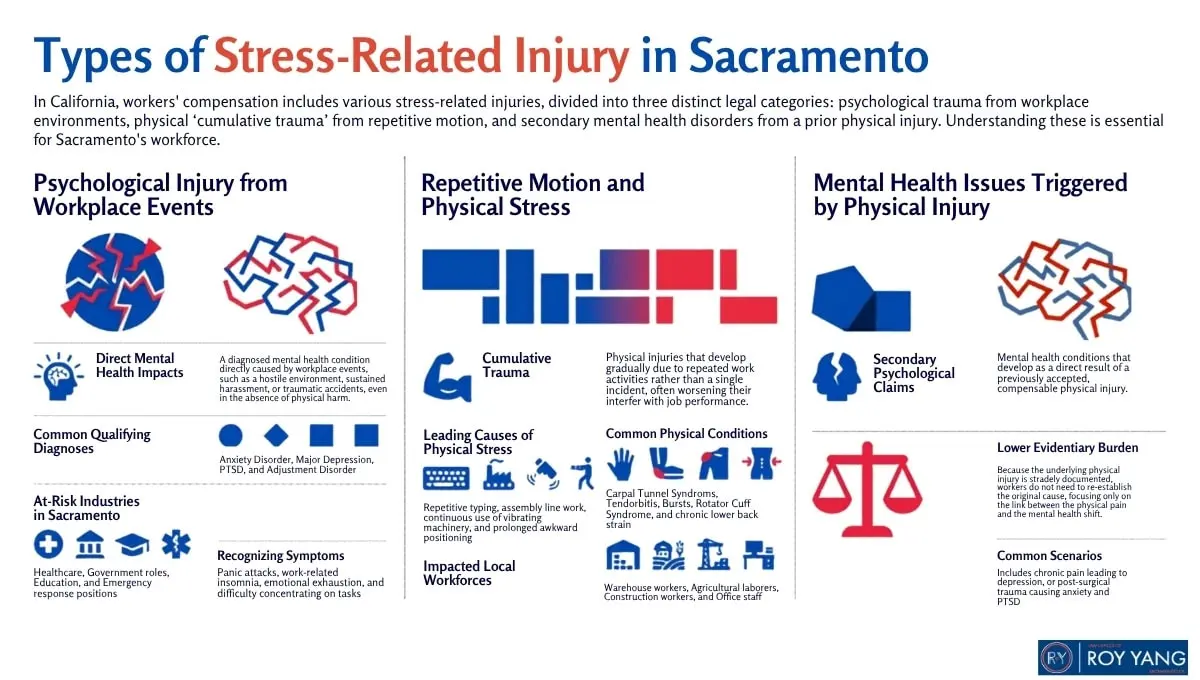
In California, three main categories of stress-related injuries qualify for workers’ compensation: psychological injuries caused by workplace events, physical conditions from repetitive work, and mental health disorders that develop after a work-related physical injury.
Psychological Injury from Workplace Events
A psychological injury occurs when a diagnosed mental health condition is directly caused by actual events at work, even without a physical injury.
Common situations that lead to a valid claim include:
- Hostile work environment or sustained harassment causing stress disorders
- Traumatic workplace events or accidents causing PTSD
- Excessive workload or sustained pressure causing burnout
- Retaliation or adverse employment action causing anxiety disorders
Qualifying diagnoses include anxiety disorder, major depression, PTSD, and adjustment disorder.
Workers may experience symptoms such as:
- Anxiety and panic attacks tied to work situations
- Insomnia caused by workplace stress
- Difficulty concentrating on tasks
- Emotional exhaustion from sustained pressure
- PTSD flashbacks of workplace events
- Sustained loss of interest in work or life activities
In Sacramento, these claims are commonly filed by employees in healthcare, government roles, education, and emergency response positions where workplace stress becomes medically significant.
Repetitive Motion and Physical Stress Injuries
Cumulative trauma is a physical injury caused by repeated work activities over time, not a single incident. These injuries develop gradually and worsen until they interfere with your ability to perform your job.
Common causes include:
- Repetitive motion from typing, assembly line work, or data entry
- Continuous use of vibrating tools or machinery
- Prolonged sitting, standing, or awkward positioning over work shifts
Common conditions include carpal tunnel syndrome, tendonitis, bursitis, rotator cuff syndrome, and lower back strain. Some of these conditions also qualify as occupational diseases under California workers’ compensation, particularly where prolonged workplace exposure is the documented cause. Symptoms include pain that increases with movement, numbness or tingling in affected areas, joint stiffness after work shifts, swelling in the wrists, hands, shoulders, or knees, and reduced strength or limited range of motion.
These injuries are common among Sacramento warehouse workers, agricultural laborers, construction workers, and office staff, where repetitive tasks are part of daily work.
Mental Health Issues Triggered by Physical Injury
A mental health condition that develops after a compensable physical injury qualifies for additional workers’ compensation benefits. Because the underlying physical injury is already accepted as work-related, these claims carry a lower evidentiary burden than standalone psychiatric claims.
Common scenarios include:
- Chronic pain from an orthopedic injury, causing depression or adjustment disorder
- Post-surgical trauma or medical complications causing anxiety or PTSD
- Accident-induced PTSD from the traumatic nature of the original injury event
Workers who develop depression, anxiety, or PTSD after a physical injury can pursue additional compensation without re-establishing how the original injury occurred. The focus shifts entirely to connecting the mental health condition to the existing work injury.
Common Causes of Workplace Stress Injuries
Stress injuries in workers’ compensation arise from specific, documented work conditions, not general life stress. Identifying the correct workplace cause is the foundation of a compensable claim.
Physical Causes
A physical cumulative trauma claim is built on the connection between a specific job task and the resulting condition. The more clearly that connection is documented, the stronger the claim. Commonly recognized physical causes include:
- Prolonged typing, mouse use, and daily data entry tasks
- Regular heavy lifting as part of job duties
- Continuous assembly line or production work
- Long-term use of vibrating tools such as jackhammers or power drills
- Sustained awkward postures, including bending, reaching, or standing for extended periods
- Repetitive scanning or item handling at fixed workstations
Because cumulative trauma builds without a single identifiable injury date, documenting your symptoms as soon as you connect them to your job is critical. Medical records tied to specific job tasks are the foundation of a physical stress claim.
Psychiatric Causes
Psychiatric stress injuries qualify under California workers’ compensation when caused by identifiable workplace conditions that go beyond normal job expectations. Recognized causes include:
- Exposure to workplace violence or credible threats
- Ongoing harassment, bullying, or a hostile work environment
- Excessive workload or unrealistic performance demands
- Chronic understaffing that creates unsafe or unmanageable conditions
- Retaliation after reporting an injury or workplace safety issue
Routine job pressure or standard management actions do not qualify on their own. The condition must result from work circumstances that exceed what a reasonable employee would typically experience in the same role.
Legal Standards for Workplace Stress Claims in California
California workers’ compensation law sets specific legal thresholds that determine whether a workplace stress injury claim qualifies. These rules apply more strictly to psychiatric stress claims than to physical cumulative trauma cases, which is why mental health claims are more frequently disputed or denied.
Causation Standard
The level of work-related causation required depends on the type of injury:
- Physical cumulative trauma: California Labor Code § 3208.1 recognizes this injury type. To qualify, work only needs to be a contributing factor, without the minimum percentage required for psychiatric injuries.
- Psychiatric stress injuries: Work must be the predominant cause, meaning more than 50 percent of all contributing factors combined under § 3208.3(b)(1).
- Violent workplace events: If the psychiatric injury results from a violent act, the threshold is reduced to a substantial cause, 35-40%, under § 3208.3(b)(2)–(3).
Six-Month Employment Requirement
Psychiatric stress claims require at least six months of employment with the same employer under § 3208.3(d). The six months do not need to be consecutive, and this requirement does not apply to physical cumulative trauma claims. It is waived when the psychiatric injury results from a sudden and extraordinary employment condition.
Good Faith Personnel Action Defense
A psychiatric claim is barred if the condition was substantially caused by a lawful, nondiscriminatory, good faith personnel action: a performance review, discipline, demotion, or termination, under § 3208.3(h). The defense does not require the personnel action to be the only cause. Employers and insurers frequently raise this defense. It can be challenged with documented evidence showing the injury was caused by broader workplace conditions, not the employment action alone.
Medical Diagnosis Requirement
Psychiatric claims must be supported by formal medical evidence:
- A diagnosis must come from a licensed psychiatrist or psychologist
- The condition must meet DSM-5 clinical criteria
- Self-reported stress, anxiety, or burnout alone is not sufficient
Without proper medical documentation, the claim will not meet DWC or Workers’ Compensation Appeals Board (WCAB) standards.
Compensation Available for Workplace Stress Injuries in Sacramento
An approved workplace stress injury claim provides four categories of workers’ compensation benefits under California law.
Medical Treatment
All reasonable and necessary medical care related to your injury is covered. This includes psychiatric evaluations, therapy, prescription medications, physical therapy, and surgery where medically indicated. Treatment is provided through the employer's Medical Provider Network (MPN).
Temporary Disability (TD)
If your condition prevents you from working during recovery, temporary disability benefits replace lost income at two-thirds of your average weekly wage, subject to statute limits, for up to 104 weeks within a five-year period.
Permanent Disability (PD)
If your injury results in lasting impairment, a Qualified Medical Evaluator (QME) rates your impairment under the AMA Guides, for both physical and psychiatric conditions. Your disability rating determines the amount and duration of payments.
Supplemental Job Displacement Benefit (SJDB)
If you cannot return to your previous job and your employer does not offer suitable modified work, you are entitled to a $6,000 voucher covering retraining, education, or skills development.
These benefits can be resolved through a Compromise and Release (C&R): a lump-sum settlement based on your disability level, future medical needs, and lost earning capacity. Once approved by a workers’ compensation judge, it closes all future claim rights.
If you’re uncertain what benefits apply to your situation, a free case review can help clarify your options at no cost.
What Should I Do After a Workplace Stress Injury in Sacramento?
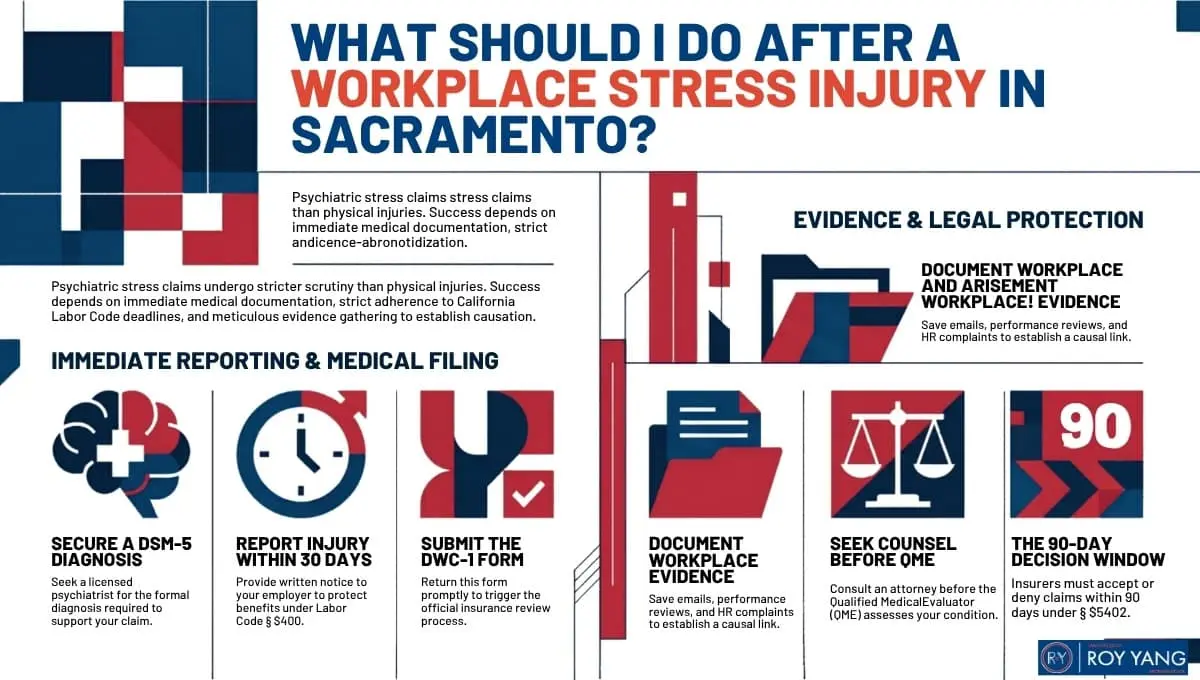
The steps you take in the first few days after a workplace stress injury can significantly impact your claim. Psychiatric stress claims are often reviewed more closely than physical injuries, which makes early medical documentation and timely reporting especially important.
Step 1: Seek Medical Attention Immediately
For physical conditions, visit a workers’ compensation-approved provider. For psychological injuries, seek evaluation from a licensed psychiatrist or psychologist. A formal DSM-5 diagnosis is required to support a psychiatric stress claim.
Step 2: Report Your Injury to Your Employer Within 30 Days
Report in writing and keep a copy. Failing to meet this deadline puts your workers’ compensation benefits at risk under California Labor Code § 5400.
Step 3: Complete the DWC-1 Claim Form Promptly
Your employer must provide a DWC-1 form within one working day of learning about your injury. Fill it out carefully and return it promptly. This form opens your claim and triggers the insurance process.
Step 4: Document Workplace Evidence
Keep a detailed record of incidents, including dates, events, and how they affected your mental health. Save emails, HR complaints, performance reviews, and supervisor communications. This evidence establishes causation and counters defenses raised by your employer or insurer.
Step 5: Get Legal Guidance Before a QME Is Assigned
The insurer has 90 days to accept or deny your claim under § 5402. A Qualified Medical Evaluator (QME) will be assigned to assess your condition, and that report directly influences your benefits.
Our attorneys review your claim, prepare the medical record, and ensure your position is protected before that evaluation takes place
Why Choose Roy Yang Law for Your Sacramento Stress Injury Claim
Choosing the right attorney before a Qualified Medical Evaluator (QME) is assigned directly influences how a psychiatric stress injury claim is developed and evaluated. At Roy Yang Law, we represent injured Sacramento workers whose psychiatric stress claims face scrutiny, disputes, and denials under California workers’ compensation.
20+ Years Representing Injured Workers
Roy Yang has represented injured workers across Northern California for more than 20 years, including psychiatric stress and cumulative trauma cases. He understands how insurers evaluate claims and build early denial strategies.
Direct Handling of All Insurer Communications
Our team handles insurer communication on your behalf, including responses to requests, disputes over disability ratings, and settlement negotiations, helping reduce pressure and protect claim value.
Case Development Before QME Evaluation
Medical records, workplace documentation, and supporting evidence are developed early to strengthen causation and address common insurer defenses in stress-related claims.
WCAB Representation if Your Claim Is Denied
If a claim is denied, representation continues before the California Workers’ Compensation Appeals Board (WCAB), where the case is presented before a workers’ compensation judge.
No Fee Unless There Is a Recovery
No upfront attorney fees. Payment is due only if there is a recovery, with terms clearly outlined in the written fee agreement.
What To Do After a Workplace Vehicle Accident To Protect Your Claim
The steps you take after a workplace vehicle accident directly determine the strength of your workers’ compensation claim.
Step 1: Call 911 and document the scene
A police report creates an official record of the accident. Photograph the vehicles, accident location, road conditions, and visible injuries. Collect names, contact information, and insurance details from all drivers and witnesses.
Step 2: Seek medical care immediately
Seek medical evaluation even if you feel no immediate symptoms. Symptoms from vehicle accident injuries often appear hours or days later. Tell the provider your injury is work-related and follow all medical advice.
Step 3: Report the accident to your employer the same day
You have 30 days to report your injury under California Labor Code §5400. Missing this deadline gives the insurer grounds to deny your claim.
Step 4: Request and complete the DWC-1 claim form
The DWC-1 form is the official California workers’ compensation claim form. Your employer must provide it within one working day of learning about your injury under Labor Code §5401. Fill it out completely and return it promptly. Once the insurer receives the form, a 90-day clock starts: if they do not issue a denial within that window, your claim is presumed accepted.
Step 5: Preserve vehicle evidence
Do not repair the vehicle before a lawyer reviews it. Vehicle condition at the time of the accident is critical evidence.
Step 6: Contact a Sacramento workplace vehicle accident attorney
Knowing when to hire a workers’ comp lawyer matters. The earlier you have legal representation, the less room the insurer has to build a case against your claim. Our team ensures your filing is handled correctly from day one.
Hear What Our Clients Say
Stress Injury Claims FAQ
What Does "Predominant Cause" Mean for a Psychiatric Stress Claim?
Predominant cause means work must be responsible for more than 50% of all contributing factors under § 3208.3(b)(1). If the injury resulted from a direct violent act at work, the threshold drops to 35–40% substantial cause.
How Long Do I Have to Report and File a Workplace Stress Injury Claim in Sacramento?
Report your workplace stress injury to your employer within 30 days. Filing deadlines vary depending on when you knew or should have known the condition was work-related. Confirm your specific deadline with an attorney.
Does the 6-Month Employment Rule Apply to All Stress Injury Claims?
No. The 6-month employment rule applies only to psychiatric stress claims, not physical cumulative trauma claims. It is waived when the psychiatric injury resulted from a sudden and extraordinary employment condition.
What If My Employer Says My Stress Came From a Performance Review or Demotion?
It depends on the full circumstances. A psychiatric claim is barred if the condition was substantially caused by a lawful employment action under § 3208.3(h); the personnel action does not need to be the only cause. If broader workplace conditions contributed to the injury, the good-faith personnel action defense can be challenged with documented evidence.
What Happens if I Already Had Anxiety or Depression Before My Workplace Stress Injury?
A pre-existing condition does not disqualify your claim. California workers’ compensation covers psychiatric injuries where work is the predominant cause of the current condition, even if a prior condition exists.
Can I File a Stress Injury Workers' Comp Claim After Being Laid Off or Fired?
Yes. A stress injury workers’ comp claim can be filed after termination if the injury occurred during employment. Claims filed after notice of termination face additional scrutiny. Documentation of the workplace conditions that caused the injury is critical.
Can I File a Workers' Comp Claim for Burnout?
Yes. Burnout is not a standalone DSM-5 diagnosis, so the claim will be filed under the formal condition your psychiatrist assigns, most commonly adjustment disorder, major depressive disorder, or an anxiety disorder. What matters legally is that the diagnosis meets DSM-5 criteria and is predominantly caused by actual events at your job.
Contact a Sacramento Stress Related Injury Lawyer Today
If you are dealing with a workplace stress injury, acting quickly can make a real difference in your claim. Delays can lead to gaps in your medical records, give the insurance company more room to dispute your condition, and put your right to benefits at risk if deadlines are missed.
Getting legal help early helps protect your documentation and strengthens your case from the beginning.
Call us at (888) 975-2889 or schedule your free case review.
Get a free, no-obligation case evaluation from an experienced workers’ compensation attorney.
Or fill out the form
"(Required)" indicates required fields

No fee unless we win
Injured on the Job? Contact Us.
Know your rights, secure benefits, get treatment, and protect your family’s future. We’re here to help. Contact us.
"(Required)" indicates required fields