

Are standard workers’ compensation benefits enough to cover the full scope of your injury? Often, the answer lies in utilizing third-party liability in workers’ compensation cases. This legal option applies when someone outside your employer’s control is responsible for your work injury. It could be a contractor, vendor, driver, or any person or company that wasn’t part of the employer-employee relationship but still contributed to your workplace accident.
Workers’ compensation provides benefits irrespective of who caused the injury. Still, it has its limits: it will not compensate you for everything you have lost, especially not pain, suffering, or future impacts on your life. When someone else was at fault, California law gives you the right to file a separate civil claim. And for many injured workers, that’s the only path to real justice and full financial recovery.
Legal Basis of Third-Party Claims in California Work Injuries
California Labor Code 3852 gives injured workers the right to take a civil action against any third person. It can be any entity or organization whose careless actions or safety inactions proximately caused the injury during the course of employment. Unlike workers’ compensation, which covers your job injury regardless of who’s responsible for it, third-party claims are different.
Legal Distinction Between Workers’ Comp and Third-Party Claims
Workers’ compensation (a no-fault system) and a third-party civil lawsuit are two separate legal paths. You can claim them in parallel at the same time, but they’re not the same legal concept.
Here’s a quick side-by-side breakdown:
| Key Difference | Workers’ Compensation | Third-Party Lawsuit |
|---|---|---|
| Proving Fault | No proof of fault required | Requires proof of negligence or wrongdoing |
| Who You Can File Against | Your employer’s insurance | A non-employer at fault for your injury |
| Where It’s Filed | Through California’s workers’ comp system | In California civil court |
| Covered Damages | Medical bills, wage loss, disability, some mileage, or retraining | Broader damages for pain and suffering, emotional distress, long-term income loss |
| Right to Sue | You cannot sue your employer for the injury | You can sue a liable third party |
| Pain & Suffering | Not available | Yes, it can be part of the compensation |
| Punitive Damages | Not available | Available in rare cases of gross negligence or intentional harm |
| Timeline & Process | Faster administrative process | Slower, formal legal process with multiple phases |
| Recovery Limits | Capped benefits based on state schedules | No fixed caps on damages based on fault and evidence |
| Can You Receive Both? | Yes, but no duplicate compensation for the same loss | Yes, as long as the damages don’t overlap with your workers’ comp benefits |
Role of Negligence and Liability in Third-Party Cases
In order to file a third-party negligence claim, the law requires something that workers’ comp doesn’t: proof of negligence. In California law regarding negligence, for the third party to be liable, four elements need to exist:
- Duty of Care: The third party had a legal obligation to act with reasonable care
- Breach: They failed to act safely or responsibly
- Causation: Their failure directly caused or contributed to your injury
- Damages: You suffered harm physically, financially, or both
In plain terms, if you can establish these four elements in your case, you may legally and financially hold third parties liable.
Circumstances Where Third-Party Claims are Allowed Under California Law
While not every workplace injury leads to a third-party lawsuit, there are obvious situations where the law permits it. The circumstances may be when the work-related injury is caused by:
- A person or entity not employed by the worker’s company
- Poor quality equipment supplied by a third-party supplier
- Unsafe conditions on a site owned or managed by an entity separate from the employer
- A negligent driver not operating on behalf of the employer
These third parties in workplace injuries fall outside of the shield that protects employers under workers’ compensation, which means they can be sued.
Burden of Proof Requirement in Civil Liability Claims
In a civil action against a third party, the injured worker (plaintiff) has the full burden of proof. To establish the liability of the third party, the plaintiff must show through a “preponderance of the evidence” that the third party negligently caused the injury. That is, the legal standard requires showing that it is more probable than not, i.e., greater than a 50% probability, that the third party’s negligence directly caused the injury.
Legal Doctrines That Influence Third-Party Work Injury Claims
Several legal rules influence fault and recovery limits in third-party liability claims and determine how they interact with workers’ compensation. Three of the most common doctrines that come into action include the following:
- Comparative Fault: Under California’s pure comparative fault system, you can still recover damages from a third party even if you were partially responsible for the accident. This is known as shared liability, and your recovery is reduced only by the percentage of fault assigned to you.
- Exclusivity Rule of Workers’ Comp: Generally, you cannot sue your employer for on-the-job injuries, no matter how negligent they have been. But this rule does not protect third parties and gives you the right to file a separate civil claim against them.
Who Qualifies as a Third Party in a Work-Related Injury Claim?
The third parties responsible for your injury aren’t protected by workers’ comp immunity, which means you can sue them in civil court while still receiving your workers’ comp benefits. The key is knowing who counts and how they’re legally separated from your employer.
Common qualifying entities in California third-party work injury claims may include:
- Independent contractors or subcontractors working alongside your team
- Vendors or service providers hired from outside companies
- Equipment or parts manufacturers
- Property owners not affiliated with your employer
- Commercial drivers or third-party delivery personnel
The key legal point: if that person wasn’t employed by your company, they’re likely considered a third party, even if you worked on the same site or the same project.
Identifying Third-Party Liability After a Workplace Injury
After a workplace injury, the primary focus is usually on receiving medical treatment, reporting the injury, and filing for workers’ comp. So, the involvement of any outsider’s liability is often easily overlooked when identifying the injury’s cause.
Usually ignored third-party roles, especially in multi-employer job sites or during fast-moving incidents, include:
- An external cleaning company failing to mark a wet floor in an office building.
- A crane operator swinging a load carelessly.
- A material supplier incorrectly loading a vehicle, causing an injury during unloading.
- An external architect or engineer making a dangerous design flaw in a new building structure.
- A temporary staffing agency providing an improperly trained worker who causes an accident.
- A security company failing to protect workers from a third-party intruder.
An injury is rarely just an internal matter; always consider who else was present or involved.
Examples of Third-Party Liability Scenarios in California
- Vendors or service providers cause injuries through negligent work practices, such as faulty installation, failure to secure equipment, or failure to place hazard warnings.
- Tool or equipment manufacturers provide defective products, like ladders that collapse or machines with faulty safety features. This may trigger a third-party product liability claim.
- Non-employer drivers cause vehicle accidents while you’re driving for work, including rideshare collisions, delivery crashes, or commercial vehicle hits.
- Property owners or site managers fail to maintain safe conditions, leading to slips, trips, falls, or injuries from unsafe structures. This gives victims a legal basis for a premises liability claim.
- Companies in high-risk industries break state safety rules, resulting in exposure to toxic materials, explosions, or unsafe confined spaces.
When to File a Third-Party Lawsuit Alongside Workers’ Comp Claim?
In California, you don’t have to choose between workers’ compensation and a third-party lawsuit. You can file both, but you must understand how the two systems interact and how settlement terms could impact each other.
The key factors that can affect when to file a third-party liability claim:
- Ongoing Workers’ Comp Claim: You can file your lawsuit while receiving comp benefits, as long as you don’t waive your right to sue in any settlement.
- Statute of Limitations: Civil claims must be filed within 2 years in most cases (or 6 months if it involves a government agency). Late filing can bar your claim.
- Evidence Preservation: Early filing allows time to gather witness statements, site photos, equipment records, or other details that fade quickly.
- Settlement Timing: Settling your workers’ comp case too soon, especially with a waiver, could cut off your ability to pursue a civil case.
- Overlap in Damages: The sooner you coordinate both claims, the easier it is to avoid duplicate recovery issues and navigate what’s covered where.
Note: If you’re negotiating a workers’ comp settlement, don’t sign anything that affects your compensation rights until a lawyer reviews it. Some agreements include language that waives your civil claim without you realizing it.
Process for Handling Third-Party Lawsuits in California
Once your attorney files a third-party lawsuit, the process moves through California’s civil court system, which is entirely separate from the workers’ compensation board. These cases follow a more formal structure, with specific legal steps, timelines, and evidentiary rules.
Steps from Filing to Resolution in Civil Court
Here’s what typically happens during a third-party lawsuit in California, from the moment the claim begins to final resolution:
- Claim Investigation: Your legal team collects the initial facts, incident reports, and medical documentation
- Filing the Complaint: A civil lawsuit is filed in the California Superior Court, naming the third party as the defendant
- Service of Process: The defendant is formally notified of the lawsuit
- Discovery Phase: Both sides exchange information, documents, and evidence
- Depositions and Expert Review: Key witnesses and experts may give sworn testimony
- Negotiations or Mediation: Many cases settle before trial through direct negotiation or a neutral mediator
- Trial (if needed): If settlement fails, the case proceeds to court for a verdict
Some cases settle in months; others take over a year. It largely depends on the severity of the injuries, the strength of evidence, and the clarity of the fault.
Why Early Evidence Collection is Critical?
Evidence builds the credibility of the third party’s involvement in your accident and quantifies your injury and losses. And the earlier it’s gathered, the better because,
- Cleanup crews, shifting equipment, or new contractors can erase critical visual evidence.
- Witnesses can move on, forget details, or become unreachable
Service logs, inspection reports, and surveillance footage may be deleted or overwritten - Without photos or documentation, injuries and visible harm may heal before they’re properly recorded
The civil system demands proof, not just suspicion. To strengthen your proof, keep itemized records of your medical treatments, expenses, visual photos/videos of injuries, and witness details. Let a legal professional review them for admissibility.
Types of Compensation Available in Third-Party Liability Cases
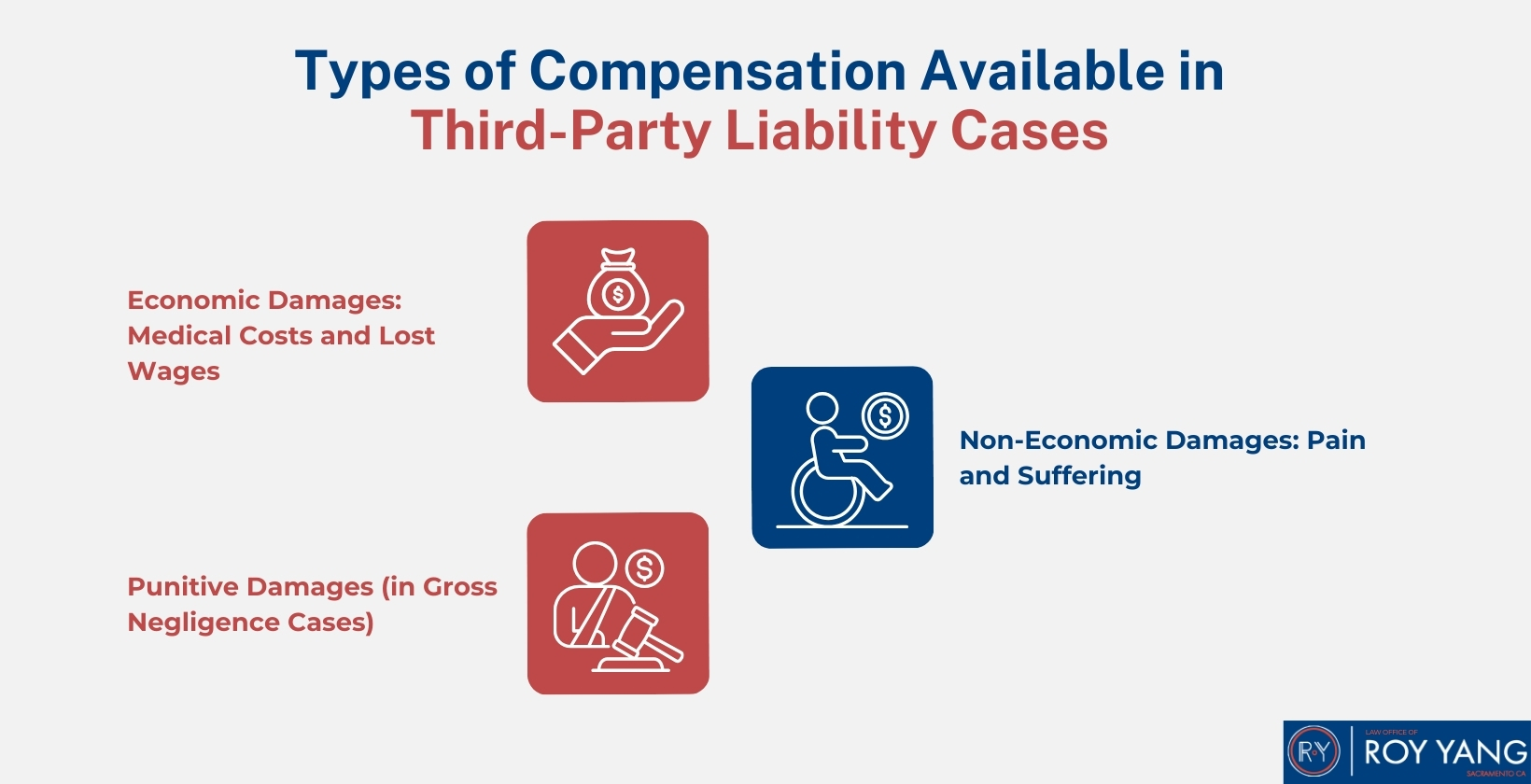
Unlike workers’ comp, which limits what you can recover, a third-party lawsuit allows broader damages, including losses that affect your quality of life. Compensation in these cases falls into three main categories: economic, non-economic, and, in rare cases, punitive.
Economic Damages: Medical Costs and Lost Wages
Economic damages are direct financial losses tied to your injury. Third-party claims can include:
- Past and future medical expenses
- Emergency care, surgeries, rehab, and medications
- Lost wages from missed work
- Reduced earning capacity if you can’t return to your previous job
- Travel costs for medical appointments
Non-Economic Damages: Pain and Suffering
Non-economic damages cover the emotional and physical toll your injury has had on your life, such as:
- Chronic pain or physical limitations
- Emotional distress or trauma
- Loss of enjoyment of life
- Impact on relationships and daily functioning
These non-tangible damages aren’t capped like workers’ comp benefits. They’re evaluated based on your personal experience and the severity of your injury.
Punitive Damages (in Gross Negligence Cases)
Punitive damages are rare but possible if proven with objective evidence. They apply when the third party acted with reckless disregard for safety or intentional harm, not just simple carelessness.
For instance, a contractor knowingly violating safety regulations or a company ignoring repeated injury complaints about faulty equipment. These damages are meant to punish bad conduct, not just compensate you.
Key Factors That Influence the Outcome of a Third-Party Settlement
Several variables impact how much a third-party case may settle for, such as:
- Strength of the liability evidence
- Quality of medical records and expert support
- Insurance coverage limits
- Long-term impact on your ability to work
- Whether workers’ comp has a lien on part of your recovery
- How soon the case is filed after the injury
A high-stakes third-party injury claim proves fault, clearly shows how the injury changed your life, and helps you recover the maximum to which you’re entitled.
How Third-Party Liability Affects Workers’ Compensation Benefits?
It is highly possible to receive financial benefits from both workers’ comp and a third-party liability suit. But there are limits to prevent duplicate payments for the same losses.
Here’s what that means in practice:
Receiving Compensation From Both Systems
While you can get workers’ compensation benefits and a third-party settlement at the same time, you can’t be paid twice for the same loss.
For example, workers’ comp may pay your medical bills and partial wage replacement. A third-party personal injury claim may simultaneously compensate you for pain and suffering, full wage loss, and future care.
This combination can significantly increase your total recovery, as long as the damages don’t overlap.
Subrogation Rights of the Workers’ Comp Insurer
If you win or settle a third-party claim, your employer’s workers’ comp insurance company has a right to receive reimbursement for what they already paid on your behalf. This is called subrogation.
Let’s take a simple example: If workers’ comp paid $30,000 in medical and wage benefits, and you later recover $100,000 from a third-party lawsuit, the insurer may claim back part of that $30,000 from your settlement.
Risk of Double Recovery and Benefit Offsets
To avoid paying for the same injury twice, the law limits double recovery. That’s when a compensation overlap appears in both claims, like lost wages or medical bills.
Potential issues with dual claims that may reduce your total insurance recovery include:
- Lien claims from the workers’ comp insurer
- Offsets that reduce your comp benefits after a third-party settlement
- Settlement clauses that accidentally waive future recovery rights
- Reimbursement demands tied to specific medical services or disability checks
This is why coordination between the two claims is essential, especially during settlement.
What to Do After a Workplace Injury Potentially Involving a Third Party?
If you’re injured on the job and suspect someone outside your workplace played a role, take immediate protective measures. Here’s what to do right away:
- Report the occupational injury to your employer as soon as it happens
- Document everything with photos of the scene, the equipment, or any vehicles involved
- Get witness names and contact information, especially if third parties were present
- Request a copy of any incident or accident report
Preserve all records, like emails, receipts, timecards, or safety complaints related to the injury - Speak with a workers’ compensation attorney who also handles third-party claims
Even when you’re unsure about who caused the accident, take these steps early to protect your rights and give your legal team what they need to identify third-party liability before it disappears.
FAQs Related to Third-Party Liability In Workers' Compensation Cases
Are undocumented workers allowed to file third-party claims in California?
Yes. California law allows undocumented workers to file both workers’ comp and third-party claims if they sustained a job-site injury, just like any other employee.
Can a coworker ever be considered a third party in California?
It depends on the relationship the coworker has with your employer. If the coworker works for a different company, like a subcontractor on the same site, they may be considered a third party. Coworkers from your own company, however, cannot be a third party in your claim.
How involved will my actual lawyer be in handling my claim?
Involvement of your actual lawyer in your claim depends on factors like their work nature, case loads, and complexity of your case. Ask this question directly to clearly understand who manages your case day-to-day.
Can I pursue a third-party claim if I’m partially at fault for the accident?
Yes. California’s comparative fault law still allows recovery even if your job-related injury is partially your fault, but your compensation will be reduced by the percentage of fault you share.
What happens if my employer discourages me from filing a third-party claim?
Your employer cannot legally interfere. Discouraging or blocking you from suing a third party may be considered retaliation. You may have grounds for legal action under California labor and workers’ comp laws.
What happens if the at-fault third party has no insurance?
You can still file a lawsuit even if the at-fault third party lacks insurance, but collecting compensation may be more difficult. Your attorney can investigate other insurance policies, company assets, or other liable parties.
Will a third-party claim delay my workers’ comp benefits?
No, a third-party claim will not delay your workers’ compensation. Your workers’ comp benefits continue separately. A civil lawsuit doesn’t affect your right to receive medical or wage benefits.
How long does a third-party lawsuit take in California?
A third-party claim in California may take anywhere from several months to over a year, depending on complexity, injuries, and whether the case settles or goes to trial.
Closing Insights on Worker Rights After a California Workplace Injury
The bottom line is, not every occupational injury is just “between you and your employer.” In California, a third-party claim isn’t just about extra compensation. It’s about recognizing the full weight of what was taken from you, such as your health, your stability, and your sense of security.
Stop wondering what your claim is worth. The Law Office of Roy Yang specializes in maximizing compensation from third-party liability cases. We are ready to fight for your future.
CALL NOW for a Free Consultation: (888) 533- 8703 or Contact Us Today to start your claim review.
