





If you are injured at work in California, the workers’ compensation claim process can feel confusing and overwhelming. While it’s designed to cover medical expenses, part of the wages you lose, and disability benefits, even small mistakes can cause delays or denials. Understanding each step of the workers compensation claim, from reporting your injury promptly, getting treatment from authorized doctors, filing claim forms, to working with the insurer is essential to protect your rights and pursue the benefits you may be entitled to.
At the Law Offices of Roy Yang, we break down the California workers’ compensation process with clear timelines and practical advice so you understand your rights and options. Below is our step-by-step guide to filing a claim:
Key Takeaways
- You must report your injury to your employer immediately; delays can hurt your claim.
- Filing the DWC-1 claim form promptly is essential to begin the benefits process.
- The claims process includes investigations, medical evaluations, and strict legal deadlines.
- Delays or denials often happen due to incomplete paperwork, missed deadlines, or employer disputes.
- A workers’ compensation lawyer can guide you through the filing process, help you avoid costly mistakes, and help with denied or delayed claims.
1. Report the Workplace Injury
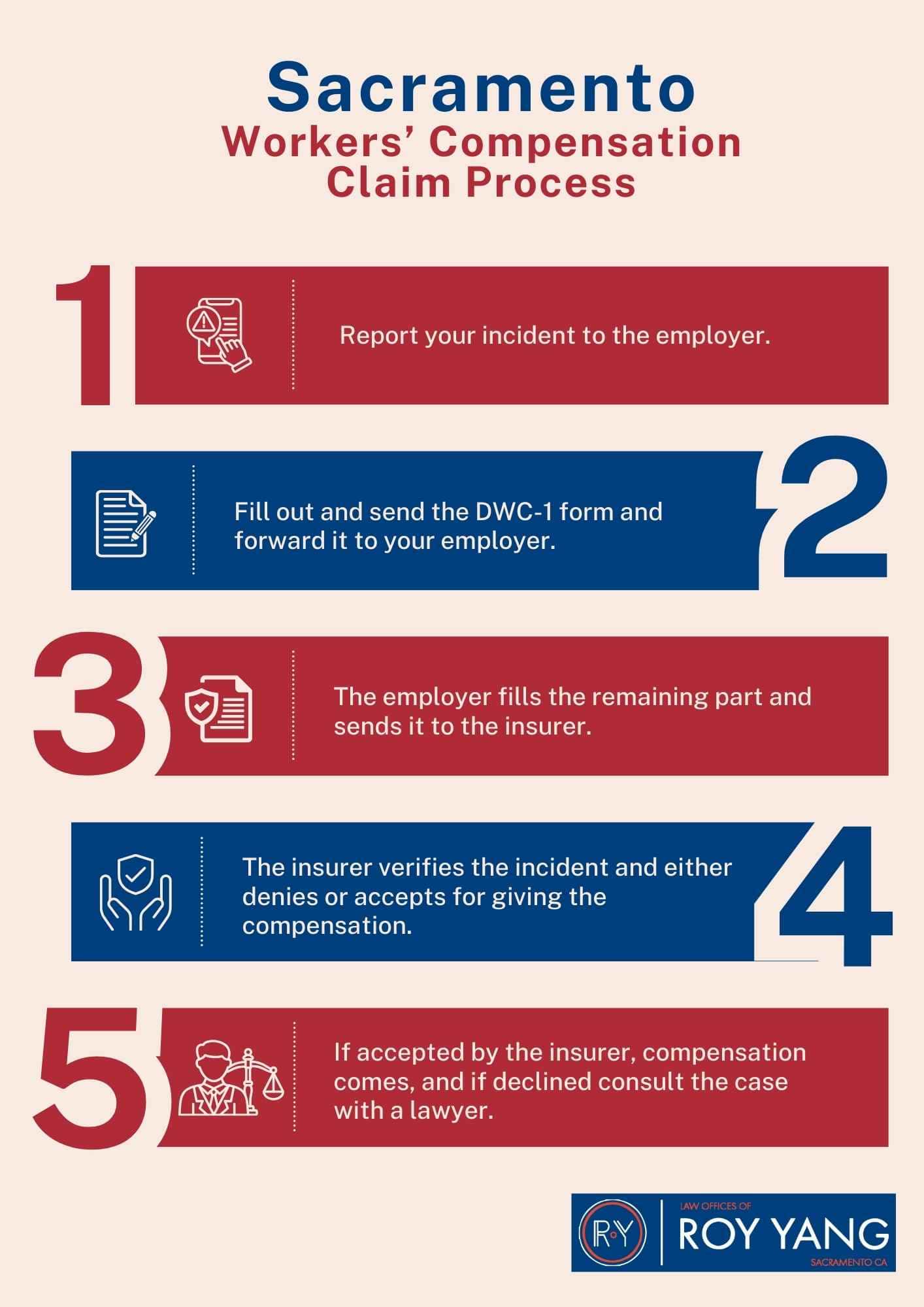
The first step in the Workers’ Compensation Claim Process is reporting your injury to your employer or supervisor. California law requires you to report work-related injuries within 30 days of the injury. If the injury developed gradually (like tendinitis or hearing loss), report it as soon as you learn or believe your job caused it.
Why Prompt Reporting Matters:
- Employers must file an official injury report (Form 5020) within five days when an injury causes lost time or needs more than first aid.
- Delays in reporting can lead to denied claims or postponed benefits.
How to Report:
1. Notify your supervisor or Human Resources (HR) department immediately.
2. Provide a detailed written report including:
- Date and time of the injury
- Location of the accident
- Circumstances of how the injury occurred
- Type of injury sustained
3. Keep a copy of your report for your records.
Prompt reporting ensures your injury is officially documented and starts your Workers’ Compensation Claim Process, protecting both your health and your right to benefits.
2. Seek Medical Treatment
Getting proper medical care is a critical part of the Workers’ Compensation Claim Process. Prompt evaluation not only ensures your health and safety but also creates the documentation to determine the severity of your injury, guide treatment, and create accurate records needed for claim approval.
Emergency Injuries:
- Call 911 or go to the nearest emergency room.
- Clearly inform medical staff that your injury is work-related.
Non-Emergency Injuries:
- Seek treatment through your employer’s workers’ compensation provider, usually within a Medical Provider Network (MPN).
- If your employer does not have a network, the insurer may choose your treating doctor for the first 30 days after your employer learns of your injury. After that, you can switch to a doctor of your choice. If you designated your personal physician in writing before the injury (and have health coverage for non-work conditions), you can see that doctor from the start.
Tips:
- Always tell your treating physician that the injury is work-related to ensure proper documentation.
- Keep detailed records of all medical visits, tests, prescriptions, and treatments.
3. File the Claim Form
After reporting your injury, your employer must provide the Workers’ Compensation Claim Form (DWC‑1) within one working day. Completing and submitting this form officially begins your California Workers’ Compensation Claim Process, allowing the insurance company to review your case and begin processing workers’ compensation benefits.
Steps to Complete the DWC‑1 Form
- Fill out the employee section accurately:
- Include your personal details
- Describe your injury
- List any treatment received
- Sign and date the form.
- Submit the form to your employer or the company’s workers’ compensation insurance carrier.
- Keep a copy for your records, as this is essential for tracking your claim.
If Your Employer Does Not Provide the Form
You can download the DWC‑1 from the California Division of Workers’ Compensation website or contact DWC directly for guidance.
4. Employer & Insurance Review
Once your DWC‑1 form is submitted, your employer completes their role and sends it to their workers’ compensation insurance company. You should receive a copy of the completed form for your records.
Insurance Company Responsibilities:
- The insurance company reviews your claim, including medical records and any statements from you, supervisors, or witnesses.
- During the review, up to $10,000 in medical treatment must be authorized, even if your claim is still being investigated.
- If no denial is issued within 90 days of the date you filed the claim form, your injury is generally presumed covered under California law.
Investigation Process:
- Reviews your medical records and treatment documentation.
- Interviews the injured employee, supervisors, or witnesses.
- Evaluates prior claims or pre-existing conditions.
This process ensures your claim is properly reviewed while allowing you to begin receiving necessary medical care promptly.
5. Medical Evaluations & Determinations
The insurance company may require a medical evaluation to fully assess your injury. These evaluations help determine the extent and severity of your injury, the recommended treatment and recovery timeline, and whether your condition results in temporary or permanent disability. Accurate medical documentation at this stage is essential, as it provides the evidence needed to support your claim and ensures you receive appropriate care.
Medical evaluations help determine the extent and severity of your injury, the recommended treatment and recovery timeline, and whether your condition results in temporary or permanent disability. Accurate medical documentation at this stage is essential, as it provides the evidence needed to support your claim and helps you receive appropriate care.
Who Conducts the Evaluation:
- Your treating doctor, who reviews your medical history and examines your injury.
- If there is a medical disagreement, a Qualified Medical Evaluator (QME) steps in or, if you have an attorney, an Agreed Medical Evaluator (AME). Both give a neutral opinion.
Medical evaluations not only guide your treatment plan but also help the insurer determine your eligibility for workers’ compensation benefits, including temporary disability or permanent impairment compensation. Keeping detailed records of all evaluations, tests, and physician notes strengthens your claim and minimizes potential disputes throughout the Workers’ Compensation Claim Process.
6. Claim Approval and Benefits
Once your claim is approved, Workers’ Compensation covers several types of benefits to help you recover, maintain financial stability, and get back to work after a workplace injury. These benefits provide medical care, financial support, and assistance if you cannot return to your previous job.
- Medical Benefits: Covers doctor visits, hospital care, surgeries, therapy, and medications related to your workplace injury.
- Temporary Disability Benefits: Two-thirds of the gross wages you lose while you cannot work during recovery, up to a weekly maximum.
- Permanent Disability Benefits:Compensation if your injury causes lasting impairment or limits your ability to work. The amount depends on a disability rating, expressed as a percentage.
- Supplemental Job Displacement Benefit (SJDB): A voucher of up to $6,000 for retraining if you have permanent partial disability.
- Death Benefits: Paid to dependents in the event of a fatal workplace injury.
7. Denials and Disputes
Not all claims are approved on the first attempt. If your claim is denied, delayed, or disputed, you still have options to protect your rights and ensure you receive the benefits you deserve. California law provides multiple ways to challenge a decision and secure fair treatment.
What You Can Do:
- You can file an Application for Adjudication of Claim (Form WCAB‑1), which officially starts the dispute process.
- You can request hearings before the Workers’ Compensation Appeals Board (WCAB). They begin with a mandatory settlement conference (MSC). If the case does not settle, it goes to trial, where you can present evidence, testimony, and supporting documents. If you disagree with the judge’s decision, you can file a Petition for Reconsideration.
- You can provide additional evidence, such as medical records or witness statements, to strengthen your claim.
- Hire a California Workers’ Compensation attorney to help guide you through the process and protect your legal rights.
Additional Options During Disputes:
- Qualified Medical Evaluator (QME): If you do not have an attorney, ask the DWC for a panel of three QMEs (Form QME 105) and choose one.
- Independent Medical Review (IMR): If the insurer denies or modifies a treatment as not medically necessary, request an IMR within 30 days of the decision. The WCAB cannot make a medical-necessity finding contrary to the IMR decision.
- Expedited Hearings: For urgent disputes, such as unpaid temporary disability or delayed treatment. You need an existing WCAB case number.
- Reopening a Claim:If your condition worsens, you can ask to reopen your case for additional benefits. You must do so within five years of the date of injury and provide a medical report supporting the worsening.
Workers’ Compensation Eligibility & Covered Injuries
Not every worker qualifies for workers’ compensation benefits in California, and not all injuries are covered. Understanding who is eligible and what types of injuries qualify is crucial before filing a claim.
Who Is Eligible for Workers' Compensation in California?
Most employees in California are covered under the workers’ compensation system. However, some exceptions exist.
Who Qualifies?
- Employees (usually paid on a W-2): Workers directly employed by a company.
- Undocumented Workers: Can receive most benefits regardless of immigration status.
- Temporary, Part-Time & Seasonal Workers: Covered if they are employees under the law.
Who Is NOT Eligible?
- Independent Contractors: Typically not covered. However, the law decides who is an employee, not the employer’s label or a tax form, so a worker misclassified as a contractor may still be covered.
- Gig Workers: Drivers for rideshare and delivery apps are independent contractors under Proposition 22 and have occupational accident insurance instead of workers’ compensation. Other gig workers may qualify as employees under the ABC test (Labor Code §2775 et seq.), case by case.
- Volunteers: Unless working for a government or nonprofit program offering coverage.
If unsure whether you qualify, consult a California workplace injury attorney to review your employment classification.
Types of Workplace Injuries & Illnesses Covered
California’s workers’ compensation laws cover injuries and illnesses due to job-related duties.
Common Work-Related Injuries Covered:
- Traumatic Injuries – Falls, machinery accidents, burns.
- Repetitive Stress Injuries – Carpal tunnel syndrome, tendonitis.
- Hearing or Vision Loss – Due to workplace conditions.
- Respiratory Diseases – Exposure to toxic chemicals or pollutants.
- Mental Health Conditions – Psychiatric injuries can qualify when actual events of employment are the predominant cause (51%, or 35% when a violent act caused the injury).
Are Repetitive Stress Injuries Covered?
Yes, injuries like carpal tunnel syndrome, tendinitis, and back strain are covered if caused by repetitive motions at work. Medical evidence must link the injury to job duties.
Essential Tips & Common Mistakes to Avoid in WC Claim Process
Navigating a California workers’ compensation claim can be complex. Keep these key points in mind to protect your rights and avoid delays or denials:
Report Injuries Promptly: Delays in reporting can jeopardize your claim. California law requires notification within 30 days.
Complete Forms Accurately: Incomplete or incorrect paperwork can cause delays or denials. Always double-check details.
Follow Up and Keep Records: Don’t assume your employer or insurer will handle everything. Maintain copies of all forms, reports, and communications.
Meet Deadlines: Appeals, filings, and other time-sensitive steps have strict timelines — missing them can cost your benefits.
Legal Counsel: Employment attorneys can assist in negotiating settlements, challenging denials, or representing you at hearings. Getting professional help early can protect your rights.
Federal Employees: Claims fall under the Federal Employees’ Compensation Act (FECA) and can be started through the ECOMP portal.
Need Help with Your Workers' Compensation Claim?
At the Law Offices of Roy Yang, we understand the challenges you’re facing when navigating the Workers’ Compensation Claim Process in California. Dealing with insurance companies, medical documentation, and strict legal deadlines can be overwhelming. Roy Yang, a workers’ compensation attorney with more than 20 years of experience, can guide you through each step, help with paperwork, and work to obtain the benefits you are entitled to. By understanding the process, keeping accurate records, and seeking professional assistance when needed, you can protect your rights and focus on your recovery.

Consult your case today and get a broader perspective on how to process a worker’s compensation claim from a Sacramento workers’ compensation lawyer at Law Offices of Roy Yang.
Don’t delay—reach out now to learn your options before the deadlines pass.
FAQs About Workers Compensation Claim Process
What happens if your claim is accepted?
If your workers’ compensation claim is accepted, you become eligible for benefits, which may include medical treatment coverage, wage replacement, rehabilitation services, and sometimes permanent disability benefits. Your employer’s insurance company will begin processing your payments, and you will likely need to follow up with assigned doctors and submit medical updates as required.
What happens if your claim is denied?
If your claim is denied, review the denial letter to understand the reason, file an Application for Adjudication of Claim with the WCAB within the legal deadline (generally one year), and consult a workers’ compensation lawyer to challenge the denial and gather evidence to support your case.
How long does the workers’ compensation claim process take?
The timeline for a workers’ compensation claim varies depending on its complexity, with simple claims often resolved in a few weeks to a few months, while claims involving disputes, appeals, or permanent disability assessments may take several months to over a year, and prompt reporting along with proper documentation can help speed up the process.
What are the things to avoid in the WC claim process?
To prevent delays or denials, avoid common mistakes such as missing deadlines for reporting injuries or filing claims, not seeking prompt medical treatment, providing inconsistent statements to your employer or insurance adjuster, sharing too much on social media which can be used against you, and failing to document the injury and its impact on your work and daily life.
Why can a workers’ compensation claim be denied?
An insurer can deny a claim when it believes the injury is not covered, for example because of late notice, missing medical evidence, or doubts about whether the injury happened at work.
What are the 5 Ws when submitting a claim?
When submitting a workers’ compensation claim, it is important to provide the essential 5 Ws: who was injured, including the employee’s details; what happened, describing the nature of the injury; when it happened, specifying the date and time; where it happened, indicating the exact location on the job; and why or how it happened, explaining the circumstances that led to the injury.
What are the stages of a compensation claim?
Most workers’ compensation claims follow these stages: report the injury to your employer, get medical evaluation, file the claim, let the insurer review it, receive a decision, appeal if necessary, and receive your benefits.
How are workmans comp claims handled?
Workers’ compensation claims are typically managed by your employer, who, as part of its responsibilities, completes its part of the claim form and sends it to the insurer; insurance adjusters, who investigate and determine benefits; medical professionals, who provide treatment and documentation; and legal representatives, who protect your rights if disputes arise.
