

A workers’ compensation deposition is a recorded question-and-answer session under oath, subject to the penalty of perjury, conducted outside a courtroom as part of your California workers’ comp case. As an injured worker, you answer questions from the insurance company’s attorney about the specific circumstances of the incident, your medical background, and how the injury affects your ability to work. A court reporter records your testimony word for word.
What you say becomes part of the official case record. Your recorded testimony goes to the doctor evaluating your disability rating and can be used at a WCAB hearing if your case stays in dispute.
Here is what to know before your deposition date, what to expect during it, and what happens after.
Why a Workers’ Compensation Deposition Happens
The insurance company requests a deposition because it needs more than paperwork to evaluate your claim. Your recorded testimony provides a direct account of your injury, your medical history, and how the injury has affected your ability to work before any legal proceedings or settlement discussions move forward.
It focuses on three areas:
- Understanding how the injury happened: Clarifies when, where, and how the incident occurred and whether it aligns with your reported job duties.
- Reviewing your medical history: Examines prior injuries, existing conditions, and current symptoms to determine whether your condition is work-related or subject to apportionment under California law.
- Evaluating credibility: Matches your answers against your DWC-1 form, treating physician notes, and employer reports. Inconsistencies give the insurer grounds to dispute your claim.
What to Expect During a Deposition in California
Here is what the workers’ comp deposition process looks like in practice.
Where and How Depositions Take Place
Most depositions take place in a conference room at the defense attorney’s office or over video. The court reporter places you under oath before questioning begins and records everything word-for-word. The setting is formal but not a courtroom.
Step By Step: How A Deposition Usually Unfolds
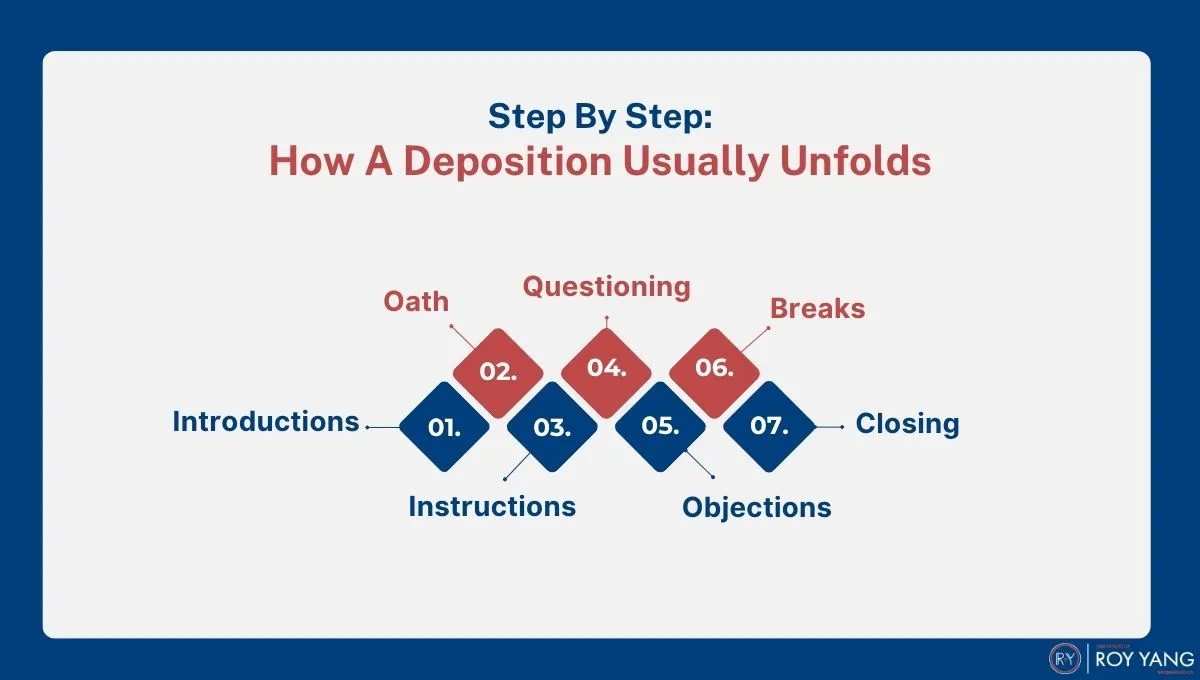
- Introductions: Everyone present identifies themselves, and you provide basic information for the record.
- Oath: The court reporter places you under oath. Your testimony carries the same legal weight as courtroom testimony.
- Instructions: Answer out loud rather than nodding, wait for each question to finish, and ask for clarification if something is unclear.
- Questioning: The defense attorney covers your injury, work history, and medical background. Answer only what is asked and do not guess.
- Objections: Your lawyer can object to inappropriate or irrelevant questions. Answer unless your attorney tells you not to.
- Breaks: Request a break at any point and speak privately with your lawyer.
- Closing: The defense attorney signals when questioning is complete, and the court reporter prepares the transcript.
Who Asks the Questions and What They Cover
The insurance company’s defense attorney leads all questioning. Your lawyer can be present to object and protect your rights. A claims adjuster may review your testimony afterward.
The questions focus on your personal background, employment history, and the injury itself. Expect to hear:
- Did you ever injure that body part before this job?
- Describe your typical workday before the injury.
- Have you seen any doctors for this condition outside of workers’ comp?
- Are you currently working in any capacity, including part-time or side work?
- Have you filed a workers’ comp claim before?
- What activities can you no longer do because of your injury?
Answer each question directly and stop. The defense attorney will follow up if they need more detail.
How Video Depositions Work in California
The oath, the court reporter, and the legal weight of your testimony are identical to an in-person session.
Use a quiet, private room with a stable internet connection. Dress the same way you would for an in-person deposition. Look at the camera, not the screen. On the other end, looking at the screen reads as looking away.
Your applicant attorney joins the same call. Request a break the same way you would in person. If you need to speak privately, the session pauses, and you step away or call your attorney directly. No one else should be in the room with you unless your attorney has specifically approved it.
Your Legal Rights During a California Deposition
California workers’ comp law gives injured workers specific, enforceable protections during depositions. These apply whether your deposition is in-person at the defense attorney’s office or conducted remotely.
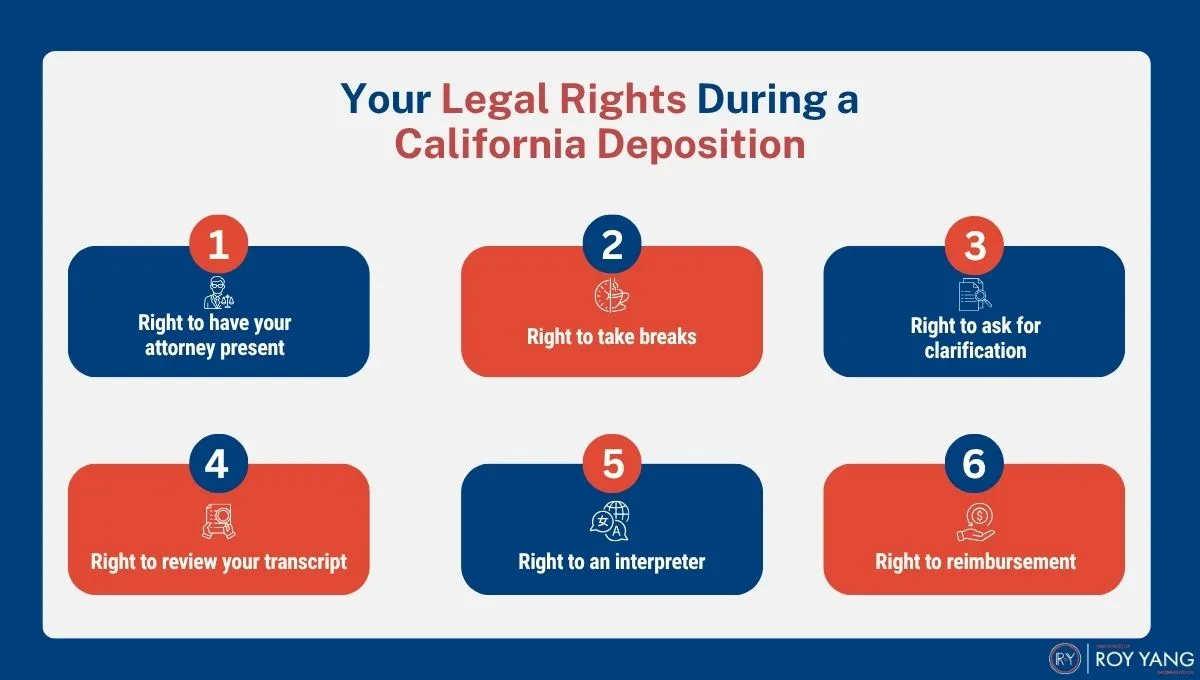
- Right to have your attorney present: Your attorney can attend, object to improper questions, and advise you throughout.
- Right to take breaks: Request a break at any point to rest or speak with your legal counsel privately.
- Right to ask for clarification: If a question is unclear, ask the defense lawyer to rephrase it before answering.
- Right to review your transcript: After the deposition, review the transcript and correct any errors before it becomes part of the official record.
- Right to an interpreter: If English is not your primary language, you are entitled to an interpreter at no cost under California law.
- Right to reimbursement: If the insurance company requests your deposition, you are entitled to reimbursement for transportation, meals, lodging, and lost wages under the California Labor Code Section 5710. The same statute limits the defense to one deposition of the injured worker.
How to Prepare for a California Workers’ Compensation Deposition
Before your deposition, sit down with your legal counsel and go through the details of your case. There are four areas to cover.
Review Your Injury and Treatment Timeline
Know the key details before you walk in:
- Date of injury and when it was reported
- Every doctor you saw and when
- Treatment received and current symptoms
- Work restrictions your physician placed on you
The defense attorney will compare your answers against your DWC-1 claim form, your treating physician’s notes, and anything you told the claims adjuster. Dates or details that don’t line up give the insurer grounds to challenge your credibility.
Understand Your Job Duties and How the Injury Happened
Be specific about what your job actually involves physically:
- How much lifting was required
- How long you were on your feet
- What repeated motions your work required
The defense attorney will also ask about your vocational history – every job you’ve held, the physical demands of each role, and any injuries or conditions from previous employment. Know this before you walk in. If a prior job involved the same body part now injured, expect the defense to use it.
What to Bring to Your Deposition
Only bring what your lawyer instructs you to. The defense attorney reviews what’s relevant, not everything blindly.
- Photo ID
- Documents your attorney asked you to bring
- Notes only if approved by your lawyer
- Your lawyer’s contact information
Manage Your Social Media Before the Deposition
Insurance companies monitor social media during active workers’ comp claims. Before your deposition, assume everything you’ve posted publicly has already been reviewed.
Steps to take before your deposition date:
- Set all accounts to private
- Stop posting about your physical activities, daily routine, or injury
- Tell family members not to tag you in photos or check-ins
- Do not delete existing posts or accounts after receiving a deposition notice
Deleting content after litigation has begun can be treated as destruction of evidence, which creates a bigger problem than the post itself.
Common Mistakes and How to Avoid Them
- Guessing or estimating answers creates inconsistencies that the defense will use against you.
- Volunteering extra information gives the defense material they wouldn’t otherwise have.
- Not listening to the full question leads to answers that miss what was actually asked.
- Using absolutes like “always” or “never” is easy to challenge when records show otherwise. A single medical record showing you occasionally performed an activity you said you never could do gives the defense what they need to attack your credibility at a WCAB hearing.
- Minimizing or overstating symptoms conflicts with your medical records.
- Forgetting prior injuries or treatment hurts your credibility if the defense finds it first.
Mistakes happen. What matters is how you handle them.
If you catch a mistake during the deposition, correct it before questioning moves on. When in doubt about any answer, stop and speak with your legal counsel.
How Your Deposition Can Affect Your Workers’ Comp Claim
The transcript from your deposition is compared against your medical records and case documents, driving every decision that follows.
- Credibility: Consistent answers build trust in your account. When what you say matches your DWC-1, your treating physician’s notes, and anything you told the claims adjuster, the insurer has less ground to challenge your version of events. Contradictions, even minor ones about dates or symptoms, become leverage in settlement negotiations and at the WCAB.
- Disability benefits: Your testimony directly affects how the QME or AME assesses your condition and limitations. Downplaying symptoms can result in a lower disability rating. Overstating them creates a credibility problem when the medical records tell a different story.
- Settlement and case direction: Consistent testimony with no credibility gaps gives your applicant attorney a stronger position in negotiations. When the deposition record and medical evidence align, insurers have less incentive to push the case to a WCAB hearing.
What Happens After a Workers’ Comp Deposition in California
- Transcript preparation: The court reporter prepares a written record of everything said during the session.
- Transcript review: You and your lawyer review the transcript and correct any errors through an errata sheet. In some California districts, the court reporter retains the original under a “per Code” process. Your applicant attorney will explain which procedure applies to your case.
- Attorney analysis: Your attorney compares the transcript against your medical records and case documents to see where your claim stands.
- QME evaluation: The transcript goes to the Qualified Medical Evaluator, or the Agreed Medical Evaluator (AME) if both sides agreed on a single doctor who uses it alongside your medical records to assess your condition, work restrictions, and disability rating.
- Settlement discussions: Once the QME report is in, your lawyer and the insurer negotiate based on the full record.
- WCAB hearing: If negotiations break down, the case goes to a Workers’ Compensation Appeals Board hearing where a judge makes the final call.
If negotiations break down, your applicant attorney files for a WCAB hearing. If the outcome results in a denial, California workers’ comp law gives you the right to challenge that decision through a formal appeal.
When to Get Legal Help for Your Workers' Comp Deposition
The defense attorney asking questions at your deposition is trained to evaluate claims and look for gaps or inconsistencies. The defense attorney has done this hundreds of times. You likely haven’t.
A workers’ comp lawyer helps you prepare before the deposition, makes objections when needed, and keeps the deposition on track so your testimony is accurately recorded throughout the process.
Consider legal representation if:
- Your claim has been denied or disputed
- You have a complex medical history or prior injuries
- Your disability rating or settlement value is being challenged
- You are unsure how to describe your job duties or injury
If you have questions about your deposition or your claim, the Law Offices of Roy Yang offers a free case review for injured workers in California.
FAQs About Workers’ Comp Depositions
Can You Refuse Or Reschedule A Workers’ Compensation Deposition?
No. Refusing a deposition can lead to your claim being suspended. You may request to reschedule for a valid reason, but you cannot refuse to participate. Contact your attorney before making any changes to a scheduled deposition date.
Can A Deposition Be Recorded On Video?
Yes. A deposition can be recorded on video in addition to the written transcript. Video-recorded testimony captures tone and demeanor and can be used as evidence at a WCAB hearing.
Do You Get Paid For Attending A Deposition?
Yes. Under California workers’ compensation law, if the insurance company requests your deposition, you may be entitled to reimbursement for lost wages, transportation, meals, and reasonable travel-related expenses.
Can Surveillance Be Used During Deposition Questioning?
Yes. Insurers may conduct surveillance and use it during questioning to challenge your statements about your injury and limitations.
What Is The Difference Between A Workers’ Comp Deposition And An Injury Case Deposition?
A workers’ comp deposition focuses on your injury, medical history, and work limitations within a no-fault system. A personal injury deposition focuses on fault, liability, and damages such as pain and suffering.
How Long Does a Workers' Comp Deposition Take in California?
Most workers’ comp depositions in California run between one and three hours. A straightforward case with one body part and limited medical history typically finishes closer to one hour. Complex cases involving multiple injuries, prior conditions, disputed causation, or a long employment history can run four hours or more.
Do Workers' Comp Cases Settle After a Deposition?
Many do. When your testimony is consistent and your medical records support your account, insurers often prefer to negotiate rather than proceed to a WCAB hearing. The deposition alone does not close the case. Settlement negotiations begin after both the deposition transcript and the QME or AME report are in hand.
How Long After the QME Report Can I Expect a Settlement Offer?
After the QME or AME issues the report, your attorney reviews it against your deposition transcript and medical records. The claims administrator has 30 days to accept the findings or request reconsideration. Settlement negotiations begin within 60 to 90 days of a final report. Cases with disputed ratings, multiple body parts, or unresolved treatment issues take longer. If the insurer disputes the QME findings, a second evaluation or a WCAB hearing follows.
