





Each year, dedicated Californians encounter workplace injuries, and many find that understanding the workers’ compensation process is key to moving forward with confidence.
While it may seem like a setback, this moment can mark the start of your recovery, not just physically, but legally and financially.
A denied claim is not the end. It’s your opportunity to take action. A denial is the claims administrator’s decision, not a judge’s, and California gives you a way to challenge it before a workers’ compensation judge.
At Law Offices of Roy Yang, we stand with injured workers throughout Sacramento and Northern California, helping them reclaim their benefits and peace of mind. There are no upfront costs-you only pay if we win.
Let’s take the next step together. Start with a free consultation and move forward with confidence.
What to Do If Your Workers’ Compensation Claim Is Denied in California
If your California workers’ comp claim is denied, review the denial letter, identify the reason, gather evidence, and challenge the denial before the deadline passes. Missing a deadline can end your right to benefits.
Understanding Why Workers’ Compensation Claims Get Denied
We know how disheartening a denial can be. Most denials fall into a handful of common categories, and knowing which one applies helps you build a strong challenge.
What Are the Most Common Categories of Denied Workers’ Comp Claims in California?
Workers’ compensation denials in California typically fall into one of five clear categories. Understanding which one applies to your case can help you take the right next step:
- Causal Relationship Dispute (Medical Non-Linkage):
The insurer disputes whether your injury arose during the normal course of employment.
Example: You develop back pain, but the employer argues it is unrelated to your job duties or workplace activities. - Failure to Provide Timely Notice (Late Reporting):
California expects you to report a work injury to your employer within 30 days. A late report can lead to denial when the delay kept your employer from investigating. If the injury developed over time, report it as soon as you learn or believe your job caused it.
Example: You waited several weeks before reporting an injury sustained while lifting heavy boxes. - Lack of Substantial Medical Evidence (Incomplete Documentation):
Your claim may lack adequate medical reports, diagnostic tests, or treating physician’s opinions that establish your injury as work-related.
Example: Your case file is missing a clear medical statement linking the injury to your job. - Disputed Arising Out of Employment (AOE) / Course of Employment (COE):
The employer or insurer contests whether the injury occurred within the scope of your employment duties or on work premises.
Example: You are injured off-site during a work trip, and the employer argues the trip was personal. - Pre-existing Condition Defense:
The insurer claims your symptoms are due to a prior medical issue rather than a new workplace injury.
Example: You reinjure your knee, but the insurance carrier uses older medical records to deny the claim.
Are Off-Duty or Commute Injuries Covered by Workers’ Comp in California?
Generally, injuries that occur off-duty or during your commute are not covered by California workers’ compensation under a rule called the going-and-coming rule. However, an injury on premises the employer owns or controls is generally treated as work-related, and other exceptions exist.
Each case depends on the specific circumstances, so it is important to have an employment legal expert review your situation. You might have a valid claim, even if it seems like a gray area.
Can Paperwork Errors or Missed Deadlines Deny a Workers’ Comp Claim?
Yes. A report that comes too late for your employer to investigate, or a form with errors such as a wrong injury date, can stall or derail a claim. File the Workers’ Compensation Claim Form (DWC 1) to protect your rights and start the claim process. Your employer must give or mail you the form within one working day after learning about your injury.
Can Intoxication or Pre-Existing Conditions Cause a Claim Denial?
Yes, but the insurer carries the burden on intoxication. An employer can defeat a claim by proving that intoxication from alcohol or unlawful drug use was a proximate cause of the injury. A pre-existing condition does not by itself defeat a claim. A worker with an existing condition who is disabled by a work injury can remain eligible, although a doctor may assign part of any permanent disability to the earlier condition.
Immediate Steps to Take After Receiving a Denial Letter
Act quickly – time is limited. A denial is not the end of the road, but your window to appeal is very short. The actions you take right after receiving your denial letter can make all the difference. These early steps are critical to protecting your rights and pursuing workers’ comp benefits.
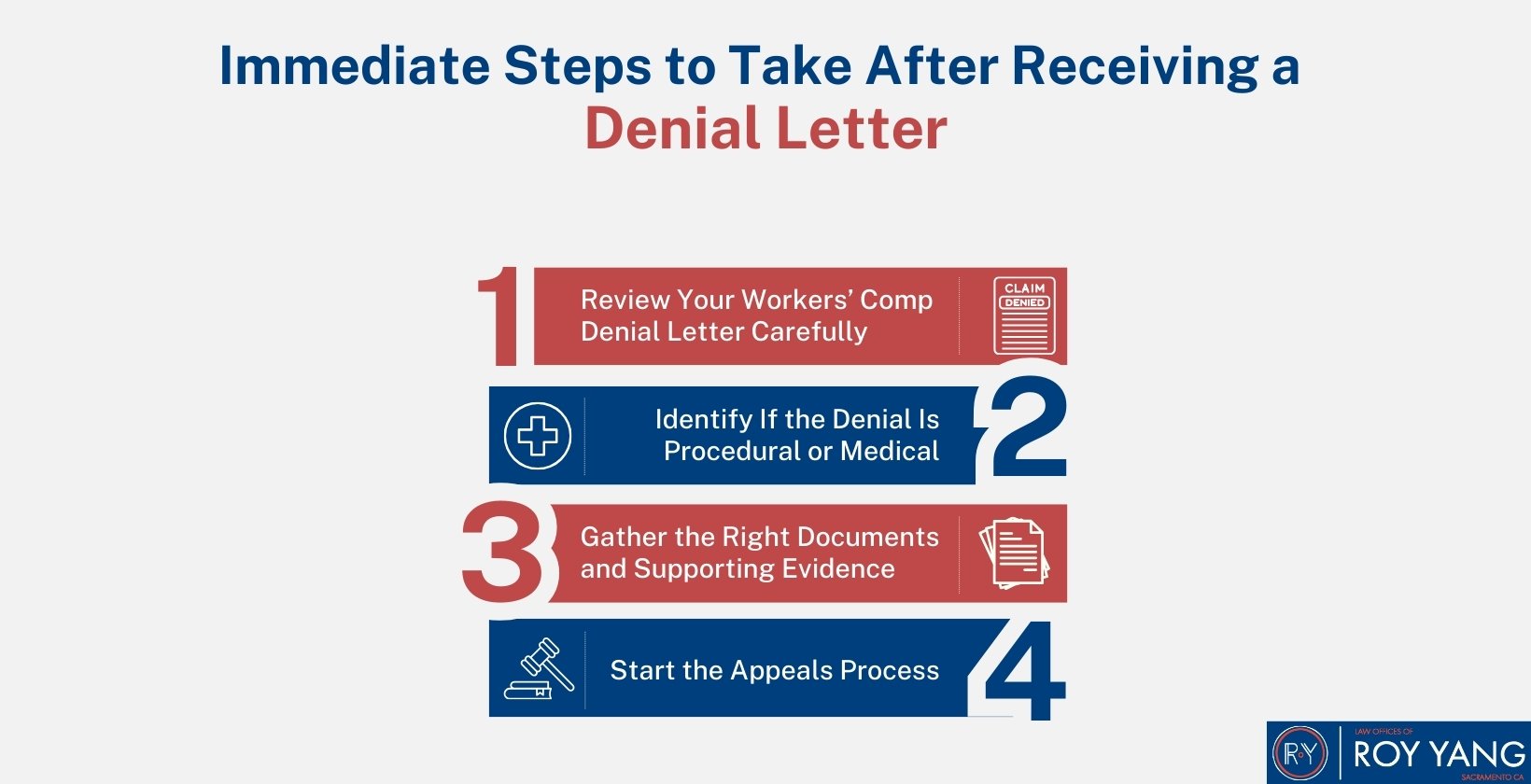
Step 1: Review Your Workers’ Comp Denial Letter Carefully
Your denial letter is the key to understanding what went wrong, and what to do next. It explains why the claims administrator denied your claim, and it may describe your options. Read it thoroughly and look for:
- The reason for denial (e.g., late reporting, insufficient medical evidence).
- Any medical reports the insurer attached.
- Any dates or deadlines the letter states.
- Instructions on how to request a hearing or reconsideration.
The stated reason decides which evidence you need next.
Step 2: Identify If the Denial Is Procedural or Medical
Your next step is to identify the type of denial you received. Most workers’ comp denials fall into one of three common types:
| Denial Type | What It Means | What to Do |
|---|---|---|
| Procedural | Technical errors, such as incomplete forms or a late report. | Correct the paperwork or clarify the facts, such as when your employer learned of the injury. |
| Medical | Based on disagreement about whether the injury is work-related. | Supply more medical evidence, such as doctor reports and diagnostic records. |
| Treatment | The insurer refused a specific treatment your doctor recommended. | Ask for independent medical review (IMR) within 30 days of the decision. |
Step 3: Gather the Right Documents and Supporting Evidence
Gather these documents to strengthen your appeal:
- Collect complete medical records.
- Ask your treating physician for a written report on whether the injury is work-related.
- Record coworker witness statements.
- Organize wage statements and incident reports.
Step 4: Start the Appeals Process
Once you have reviewed your denial letter, identified the type of denial, and gathered the necessary documents, you will be ready to move forward legally. These early steps lay the foundation for building and submitting a strong appeal.
How Do You Appeal a Workers’ Comp Claim Denial in California?
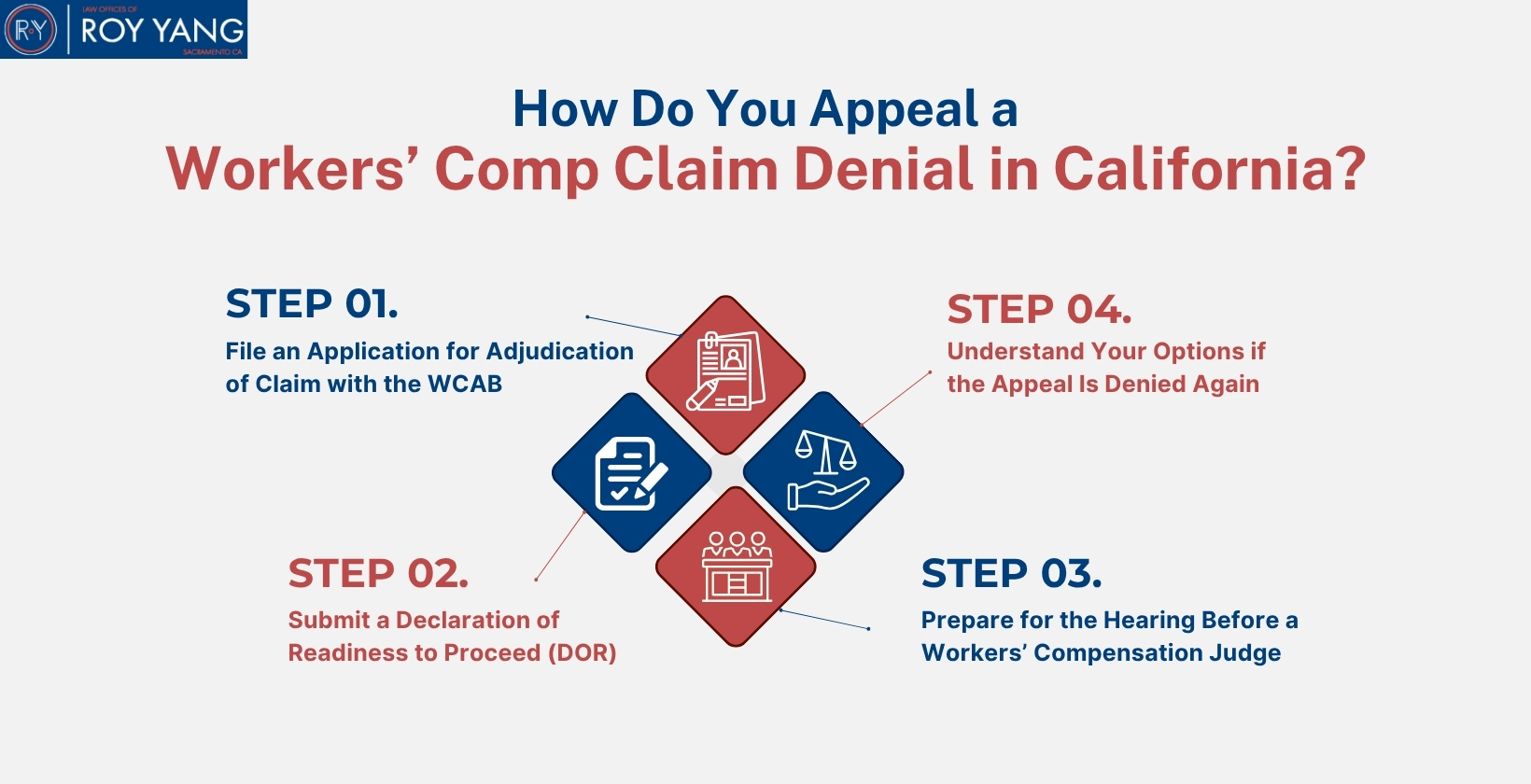
California workers’ comp law gives you a chance to fight back, but the clock is ticking. Challenging a denial starts with opening a case at the WCAB, and the workers’ comp appeal process is time-sensitive, requires proper paperwork, and often benefits from legal help. Here is a step-by-step look at how to file an appeal and protect your rights.
Step 1: File an Application for Adjudication of Claim with the WCAB
Your first move is to file an Application for Adjudication of Claim with the Workers’ Compensation Appeals Board (WCAB) in your area. Follow these steps:
- Download the Application for Adjudication of Claim form from California’s DWC website.
- Fill in your details: employer name, injury description, and insurance information.
- Attach a copy of your denial letter.
- File the form at the WCAB office for the county where you live, where you were injured, or where your attorney’s main office is.
- Send a copy to the claims administrator.
- File within one year of the date of injury, or within one year of the last time benefits were provided to you (such as medical treatment or temporary disability payments). The deadline does not restart because a claim was denied, so do not wait.
The WCAB can hear your dispute only after an application is filed.
Step 2: Submit a Declaration of Readiness to Proceed (DOR)
After submitting your application and preparing your supporting documents, the next step is to file a Declaration of Readiness to Proceed (DOR). This asks the WCAB to schedule a conference, usually a mandatory settlement conference before a judge. If the case does not settle, it goes to trial. Signing the DOR states under penalty of perjury that you are ready to proceed to hearing, so file it only when:
- You have completed discovery on the disputed issues
- All medical reports in your possession are filed and served
- You are fully prepared for a judge to review your case
Step 3: Prepare for the Hearing Before a Workers’ Compensation Judge
Your appeal will be reviewed by a workers’ compensation judge, and careful preparation is key to making a strong case that proceeds smoothly. Here is how to get ready:
- Organize Your Documents: Include medical records, your denial letter, wage statements, and any relevant correspondence.
- Line Up Witness Testimony: Coworkers, supervisors, or your treating physician can support your claim.
- Practice Telling Your Story: Rehearse several times before going to court so that you come across as clear, honest, and confident when explaining how the injury happened and how it has affected your life.
- Consider Legal Support: An experienced workers’ comp attorney in California can represent you, present evidence, and handle negotiations on your behalf.
After trial, the judge issues a written decision by mail, usually 30 to 90 days later.
Step 4: Understand Your Options if the Appeal Is Denied Again
If the judge rules against you, do not lose hope yet. You still have legal paths available:
- File a Petition for Reconsideration with the WCAB within 20 days after the judge’s final decision is served on you, or 25 days if it was mailed to a California address. Only final orders can be reconsidered.
- Ask the Court of Appeal to review. After the WCAB acts on your petition, you may apply for a writ of review in the California Court of Appeal. The application must be made within 45 days after reconsideration is denied.
- Consult with a Sacramento workers’ comp attorney to evaluate your case and decide on the strongest next move.
When and Why You Should Consider Hiring a Workers’ Compensation Lawyer?
If your workers’ comp claim has been denied, you are not alone, and you are not out of options. Consider legal help when you are unsure how to move forward, your case gets complicated, or the stakes are simply too high to risk going it alone.
When to Hire a Workers’ Comp Lawyer?
Hire a workers’ comp lawyer when:
- Your claim has been denied multiple times.
- You are dealing with serious injuries or ongoing medical care.
- The insurance company disputes your injury, wages, or treatment.
- You have missed key deadlines or paperwork.
- You are facing financial pressure with bills stacking up.
How Can a Lawyer Increase Your Chance of a Successful Appeal?
A seasoned workers’ comp attorney knows how to build a strong appeal by:
- Gathering and organizing clear medical documentation.
- Submitting complete and accurate forms on time.
- Presenting witness testimony and expert opinions.
- Arguing your case effectively at a WCAB hearing.
- Spotting insurer tactics meant to undervalue or delay your claim.
A Northern California workers’ comp lawyer can review a delayed, reduced, or denied claim and explain your options.
Avoiding Common Pitfalls After a Denied Workers’ Compensation Claim
After a denial, many injured workers feel frustrated and overwhelmed; however, small missteps can exacerbate the situation. Catching these early could mean the difference between getting your benefits or losing them for good.
What Are the Most Common Mistakes Injured Workers Make After Denial?
These mistakes often reduce your chances of success during an appeal.
- Missing Statutory Deadlines (Failure to Timely Appeal):
Example (illustrative): A worker set the denial letter aside for months, and the deadline to open a case at the WCAB passed.
Solution: Write down every date on each letter and decision the day it arrives. - Lack of Substantial Medical Evidence:
Example (illustrative): A claimant arrived at a WCAB hearing without updated records of ongoing treatment.
Solution: Keep your treatment records current and bring them to every conference and hearing. - Misinterpreting the Grounds for Denial (Failure to Understand Administrative Findings):
Example (illustrative): A worker assumed the denial accused them of fraud, when the letter cited a late injury report.
Solution: Read the denial letter carefully. If the reason is unclear, ask a workers’ comp attorney or call the DWC Information and Assistance Unit at 1-800-736-7401 for guidance. - Stopping Treatment After a Denial:
Example (illustrative): After the denial, a worker stopped seeing their doctor because of the travel distance, which made the injury’s severity harder to document.
Solution: Continue prescribed treatment and attend follow-up appointments so your condition stays documented. - Pro Se Representation Without Legal Guidance:
Example (illustrative): A worker represented himself before a WCAB judge and was unprepared for legal procedures or cross-examination.
Solution: Hire a California workers’ compensation attorney. Roy Yang has practiced workers’ compensation law in California since 2005, and before representing injured workers he defended insurance companies in these cases.
Can Missing an Appeal Deadline End Your Right to Benefits Permanently?
Yes. In California, strict deadlines apply to workers’ comp appeals. If you miss the deadline to file an Application for Adjudication, your case may be permanently closed, no matter how valid your claim is. A missed reconsideration deadline can end review of a judge’s decision. Always check every letter and decision for exact dates and act immediately.
Strategies to Strengthen Your Claim Before and During the Appeals Process
Strengthen your claim with medical evidence, timelines, and witness support before your appeal hearing. The right documentation, structure, and preparation can make all the difference in the outcome. Use the following checklist to give your appeal the best possible foundation.
Step 1: Prioritize Strong Medical Documentation and Ongoing Treatment
Solid medical evidence is the foundation of a successful workers’ comp appeal. Without it, a workers’ compensation judge may question the seriousness, or even the existence, of your injury. To strengthen your case, focus on the following:
- Attend all medical appointments and follow your doctor’s recommended treatment plan.
- Keep copies of every medical report, test result, and prescription.
- Ask your provider for written diagnoses and treatment summaries that clearly link your condition to your work injury.
- Track your symptoms and limitations after each visit to show the ongoing impact of your injury.
Thorough, up-to-date medical records help establish that your injury is legitimate, work-related, and still affecting your ability to work.
Step 2: Gather Supporting Evidence from Witnesses and Medical Experts
When your employer or insurer disputes how your injury happened or whether it is work-related, statements from others can decide the case.
- Request witness statements from coworkers or supervisors who were present. Ask them to clearly describe what they saw, including the time, location, and conditions.
- Obtain written opinions from your treating physician or a medical specialist that directly link your injury to your work duties.
- Use expert testimony if your case involves complex medical issues or long-term disability concerns.
Example witness statement:
“I saw Employee 1 slip on the wet warehouse floor near loading dock B on June 14. He fell hard on his back and couldn’t stand without assistance.”
These types of statements strengthen your case by backing up your account with credible, independent observations and professional insights.
Step 3: Keep Detailed Records of Your Recovery and All Communication
Consistent documentation shows that you are actively engaged in your recovery and strengthens your credibility during the appeal process. It also helps track your progress and build a complete picture of how the injury has impacted your life.
What to track:
- All doctor visits, therapy, and rehabilitation appointments
- Time missed from work and any lost wages
- Emails, letters, and phone calls with insurance adjusters or your employer
- Daily pain levels, physical limitations, and how they affect daily activities
- Mileage, transportation costs, or out-of-pocket expenses related to treatment
- A dated timeline of events from injury to treatment, denial, and next steps
Tip: Use a notebook, spreadsheet, or mobile app to stay organized and ensure nothing slips through the cracks. The more thorough your records, the stronger your case.
How Much Does It Cost to Hire a Workers’ Compensation Lawyer in California?
Hiring a workers’ compensation lawyer in California comes with no upfront cost. Most attorneys work on a contingency fee basis, meaning they only get paid if you win your case or secure a deserved workers’ comp settlement. This makes legal help accessible, even if you are facing financial pressure after a work injury.
A workers’ compensation judge must approve every attorney fee. The fee comes out of some of your benefits later, so you don’t pay it up front. An attorney cannot collect money from you for representing you before the WCAB until the fee is approved.
| Fee Type | Amount/Range | When It Applies |
|---|---|---|
| Contingency Fee | Usually 9% to 15% of a permanent disability settlement or award | Approved by a workers’ compensation judge and taken from some of your benefits later |
| Upfront Costs | $0 | No fees paid to take on and begin your case |
How to Cover Medical Costs While Your Workers’ Comp Case Is Pending or Denied?
Waiting for a decision on your workers’ comp claim can be stressful, especially when the medical bills are not going to wait for you to get paid. If your claim is still under review or was denied, you still have several options to keep treatment moving forward and protect your health.
Does the Insurer Pay for Treatment While It Decides Your Claim?
While your employer decides whether to accept your claim, you may receive up to $10,000 in medical treatment. If you have filed a claim form and the claims administrator does not deny the claim within 90 days, your injury is presumed covered.
Can You Use Group Health Insurance or Medi-Cal If Workers’ Comp Is Denied?
It may be possible. If your workers’ compensation claim is denied or delayed, you may be able to use your group health insurance or apply for Medi-Cal to continue receiving medical care. Medi-Cal members must report a workers’ compensation claim to the Department of Health Care Services within 30 days, and the department can seek reimbursement for benefits it paid.
What Is an MSA (Medicare Set-Aside) and Should You Consider Setting One Up?
A Medicare Set-Aside (MSA) is money from a settlement set aside to pay future work-related medical costs that Medicare would otherwise cover, and it can be used only for injury-related care. CMS does not require you to submit an MSA proposal for review, but it reviews one only if you are a Medicare beneficiary and the settlement exceeds $25,000, or if you expect to enroll within 30 months and the total settlement exceeds $250,000. Either way, the settlement must still protect Medicare’s interests.
A Medicare Set-Aside (MSA) is a legally designated fund from your settlement, used to pay for future work-related medical costs before Medicare covers them. Required in cases where settlement involves future medical care and you are eligible or soon eligible for Medicare.
What Are Your Legal and Support Options If Workers’ Comp Isn’t Enough?
Workers’ compensation is often the first step toward recovery, but it is not always the final solution. If your benefits fall short, your claim was denied, or your injury requires more help than workers’ comp provides, there are other legal and support options available to you.
Can You File a Personal Injury Claim If Your Employer Was Negligent?
In most cases, workers’ compensation is an exclusive remedy, meaning you cannot sue your employer for a job injury. One exception applies when your employer is illegally uninsured. You can then sue in Superior Court in addition to your comp claim. Ask an attorney whether another exception fits your facts.
You may also file a lawsuit against someone other than your employer (like a subcontractor, manufacturer, or property owner) who caused your injury. Most personal injury lawsuits must be filed within two years of the injury.
Are You Eligible For Social Security Disability Insurance (SSDI) As a Backup?
If a medical condition keeps you from substantial work for a year or more, or is expected to result in death, you might qualify for Social Security Disability Insurance (SSDI). SSA also requires recent work history, usually 5 of the last 10 years, and limits your earnings (for most workers, $1,690 a month in 2026). SSDI is a federal benefit separate from California workers’ compensation. If you receive both, SSA may reduce your SSDI so the combined payments do not exceed 80 percent of your average earnings before the disability.
Can You Collect State Disability Insurance While Your Claim Is Denied?
Possibly. The EDD says you may qualify for State Disability Insurance if your employer or its insurer delays or denies workers’ comp benefits, or if your workers’ comp benefit covers only your medical expenses. If you are not sure you are eligible, EDD advises filing a claim and letting it decide.
What Are Your Job Retraining Options After a Work Injury in California?
If your injury keeps you from returning to your old job, California’s Supplemental Job Displacement Benefit (SJDB) may help pay for retraining. You qualify only if your claim was accepted, you have a permanent partial disability, and your employer does not offer regular, modified, or alternative work within 60 days of receiving the physician’s return-to-work and voucher report. For injuries on or after January 1, 2013, the voucher is worth up to $6,000. It covers tuition and fees, books, required tools, licensing and testing fees, and limited computer and counseling costs.
Take Action to Protect Your Health and Financial Future
A denied workers’ comp claim does not automatically mean a frustrating conclusion to your case. Roy Yang and his team help Sacramento workers understand their legal rights, appeal denials, and recover the benefits they are owed. If your claim was rejected, now is the time to act. Do not let paperwork or insurer tactics cost you your shot at recovery.
Get a free consultation today. Call (888) 975-2889 or schedule your case review online to speak with a California workers’ compensation attorney.
